Recent Posts
-
I’d Prefer Not To . . .
July 13, 2026
-
Monumental Instability, or War of the Memorials
March 22, 2026
-
Yes, There IS a Future!
December 26, 2025
-
Real Crimes and the Coming Violence
September 6, 2025
-
Whither Modern Life?
June 27, 2025
-
What the Hell
June 18, 2025
-
As Darkness Engulfs Us
April 6, 2025
-
AI, Risk, and Work
January 17, 2025
-
“Things Are in the Saddle, and Ride Mankind”
December 29, 2024
-
Forgotten Futures in Seattle
December 12, 2024
|
I have to admit I’ve been a World Cup potato for the past week. I saw a lot of games, not all, but probably too many! Felt most sorry for Ivory Coast who were great, so I’m now counting on them for 2010 in South Africa. In general I root for underdogs, but still have a soft spot for Brazil. The World Cup is really the best sports event every four years.
I’ve fallen into another period of deep sadness so my normal exuberance is a missing resource for keeping this blog going. I’ve been reading a lot, of course, so I’ll give a few short reports by way of saying hello to all. First I read Atomik Aztex, a wild novel by Sesshu Foster. It tells a very strange hybrid story whipping back and forth between an Aztek warrior brigade fighting against the Nazis in Stalingrad during WWII, to an Aztek who is having delusions of being a guy working in a pork slaughterhouse in contemporary East L.A. Or is he a guy working in a slaughterhouse in East LA who has weird dreams of a parallel universe in which the Azteks defeated the Spanish and control North America? That’s the fun, and Foster’s literary pleasure in playing with spelling and language is very entertaining. I recommend this book even though I didn’t think it as great as it might have been.
My friend Heather Rogers published a book last year to accompany her documentary video of the same name, “Gone Tomorrow: The Hidden Life of Garbage.” (The website at that link is really worth a visit!) The book reads really well, does a great job of giving the history of trash and garbage management, and debunks the simplistic views that a lot of folks have about recycling (while still endorsing some aspects of a public engagement with recycling as better than not having that!). I particularly liked her ability to smoothly integrate a historic look at the various technological “fixes” for garbage (from incineration to sanitary landfill) with the critical understanding of the rise of consumerism and waste as social policy. She leans on the work of Stewart Ewen, who has several very important books about the origins of the advertising industry (Channels of Desire, Captains of Consciousness, SPIN!). His work, in turn, was taken by Adam Curtis for some of his four-part BBC documentary “Century of the Self“ which traces the career of Edward Bernays, the nephew of Sigmund Freud who gets a lot of credit for inventing modern techniques of opinion management. Anyway, Heather makes visible the always denied and invisible mountains of garbage that our daily lives create. Any thorough-going effort to redesign our lives will have to take on this overlooked nightmare, and the sooner the better!
I got sucked in to a very popular series, Philip Pullman’s “His Dark Materials” books, starting with book one, The Golden Compass. It has all the qualities that you want from this kind of thing, great characters, a twisting and unpredictable plot, and crisp writing. I found myself looking forward to curling up with this book each night for the past week as I dashed through it (but only before falling asleep). Now I’m on to the second volume, and will carry on through. The usual spate of magazines and articles and chapters in books too, of course, but they’ll get a more ample treatment in a later post. I strongly recommend reading Chris Clarke’s editorial introducing the new fall 06 issue of Earth Island Journal (they haven’t posted the piece yet). A breath of fresh sanity” he goes after the basic stupidity of the economy as a worthy way of measuring our lives. Extremely concise and on the point. Check it out!
On my recent trip to Milan for Mayday I got to meet Alex Foti over lunch. We decided to conduct an interview by email and here it is. Foti is the author of a manifesto I quoted at length in an early blog post, regardind the politics of Precarity and the so-called ‘cognitariat’ in Italy and Europe. We continue the discussion here…
1. Describe your involvement in Chainworkers. When did it start, what was the instigation? How many people have been involved with it?
Zoe and I made a trip to California and the Northwest in 1998: we were struck by the wal-martization of America and how service labor was being pitilessly exploited in offices and malls. We thought this was a trend already present in metropolitan Italy and that America in a way was showing us the bleak future in store for European precarious workers if they didn’t fight back. On the plane back, we read of a Vancouver McD’s that had just been unionized by two teen-age girls. I proposed we create a webzine, ChainWorkers.org, in order to help young temps and part-timers organize and defend themselves from greedy and manipulative employers in Milano and beyond. Zoe designed the beta version of the webzine in early 1999. Then we read NO LOGO and became Kleinian converts immediately. We presented the project of merging media+labor activism to the squat we were members of in the spring of 2000. Then the CreW was born. At its peak in 2004-2005 it involved some 50 activists who could mobilize 500 people with short notice for actions and pickets.
2. In Greenpepper you described a further entity called PRECOG, which was described as the precarious retail and service workers PLUS the cognitariat of media and education industries. Can you describe how these two disparate sectors actually connect? Are there active alliances between say, sales clerks at a department store on one hand and web workers at a media company on the other? How does that look? What do they do? Can you describe the relationship between organizing efforts among chainstore workers and cultural/media workers?
Precog was founded in late 2003 and basically lasted one year as a national online and offline network linking antiprecarity movements in main Italian cities. It created San Precario and did the most politically relevant mayday of all, that of 2004, when non-communist radical movements, pink collective and militant sections of unionism did a splash by shutting down all chainstores and supermarkets still opened on May 1st (legal holiday in Italy according to the labor code). It was a high time of interlinking ideas and struggles and everything seemed possibile. It did not last. I think precog wanted to bridge the gap between student movements and incipient struggles of service workers. Up to that moment, students had not really taken an interest in the sorry condition of the Italian labor market, with millions of their peers flexploited and discriminated. In a way the synthesis was already in the CreW, where cashiers, runners, social workers, media operatives, people with union experience were all coming together to discuss very creative ways of approaching the unorganized young people in the city. But I don’t deny there’s a problem trying to reach programmers and cleaners with the same spell. It’s the same problem that cross-class progressive alliances in the 20th century had to face. But I don’t see how we can alter the balance of power on the labor market if we don’t merge sections of the service class, with sections of the creative class, and of the knowledge class in a wider radical alliance aiming at raising conflict and provide cross-sector solidarity.
3. In Processed World magazine we began describing the rise of the “6-month worker” in our second issue in 1981. Over the years it became clear that while this was an accurate objective characterization of a growing number of people, the subjective experience of being in this category was anything but uniform. Some people want full-time work and can’t get it. Others were happy to have precarious work because it was relatively well-paid, allowing them to take time off to do their “real work.” Can you talk about the problems of the category of the “precariat” in Italy as a unifying identity?
It’s not yet an identity but it’s in the process of becoming at least a social subject aware of its potential, if an organization finally emerges addressing precarity from a generational angle (the European precariat is mostly a conflation of generation and class). Let’s talk about part-time workers. Usually these workers have no control on their work time (they’re supposed to do say 20 hours per week, but have to work 40 with no notice if managers require them to do so), and are paid per hour less than correspondent full-time workers. So clearly there are structural elements of precarity in part-time work. Also, since you work part-time you earn a partial income, and so the likelihood of moonlighting increases sharply. But there’s no doubt that while involuntary part-time is the norm, there’s a number of people that find flexible work schedules a plus for their individual freedom. In fact, we don’t want to abolish flexibility even if we could. We want to impose social regulation on it through labor conflict, social agitation, media hacktivism. Most especially (and this is were we disagree with commie parties and unions) we want to fight for a new European welfare system (call it “commonfare”) that provides the young, women, immigrants with basic income and universal access to health care, paid maternity leave and paid vacations, cheap housing and education, free, ubiquitous broadband and peer-managed culture. If such a new welfare system were to be built, then people could actually choose the level of flexibility they’re comfortable with. We are also trying to raise support for a common minimum wage in the eurozone (at a sufficiently high level, and it would be sustainable, if it is set in conjunction with a basic income). But there’s no secret about one thing. However you put it, we have to achieve a sizable redistribution of income and wealth from the upper to the lower classes. If we don’t do that, any new social measure would be perfunctory.
Continue reading Alex Foti interview
Some friends invited me to join them on a “hobo” bike ride this past Sunday. We got on BART at 16th St. at 2:30 and rode an hour to the end of the line at Pittsburg. There we rode on a multi-use path along the outer reaches of Bay Area suburbs until we reached Somersville Road and turned due south and rode straight up in to the Black Diamond Regional Preserve where there are beautiful views north over the Delta and the power plant and the huge wind farm on the other side of the Antioch Bridge.
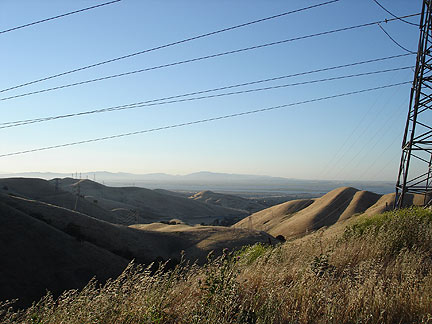
Black Diamond used to be the biggest coal mine in California during the latter 19th century, and once had 5 small towns among its steeply rolling hills. Now it’s a bucolic California countryside full of yellow hills covered in oak and buckeye.

Maybe a reader knows if the California buckeye has any medicinal or nutritional value. It seemed like maybe they’d been cultivated along this gulley, they were so thick along with the sage that you can see in the foreground. One of those bits of history-through-conjecture: did the native Indians of this area manage the landscape in such a way to promote buckeyes and sage on their path over these hills?
Continue reading Ghost towns of the Bay Area
|
Hidden San Francisco 2nd EDITION!
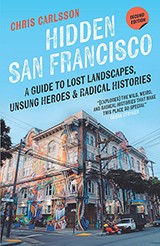
NEW 2nd EDITION NOW AVAILABLE!
Buy one here
(Pluto Press, Spring 2025)
|