

Happy end of 2025 and beginning of 2026! It’s a New Year!
The title is not merely a self-exhortation, though I suppose it could be read that way. It’s been three months since I last posted something to my blog. I did write an essay about the Rise and Fall of the Junipero Serra monument during this time, but it’s over on Foundsf.org. The essay is part of our ongoing participation in the SF Arts Commission’s Shaping Legacy Project. I’ve been resisting writing for the sake of writing, even if I’ve done that a lot over the past 21 years on this blog. I like to write—that’s no crime (yet). But given the firehose of bullshit pouring out of every channel of mainstream media (mostly deferential towards the overt fascism engulfing our society), not to mention the bizarre hyper-abundance of opinions and analyses free-floating on substack, facebook, medium, tiktok, etc., joined by several million podcasts (literally) full of even more talking and opining, the best answer might be silence. I certainly don’t feel a need to repackage and repeat what everyone else is saying.
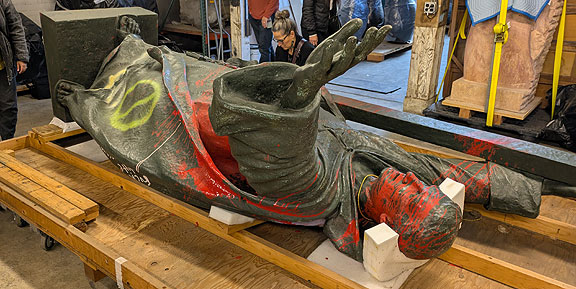
The Serra statue, stored in a warehouse after its toppling on June 19, 2020
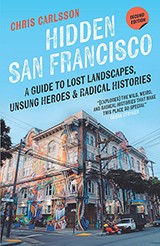
Regular readers of this blog, who are vanishingly few by now, will know that for the past several years a lot of what I’ve been doing is digesting and interpreting all the books I continue to plow through. I do prefer reading books to anything I can find online or in magazines. I gave a presentation on the 2nd edition of Hidden San Francisco at the Howard Zinn Bookfair in early December and was delighted to have a full house of about 30 people at 10:30 in the morning on a busy day full of multiple compelling programs all pitted against one another. There were sharp questions and comments, but the one that was both flattering and frankly funny, was from my old pal Joe Berry, who commanded the floor to announce that I was (one of the) “greatest living bibliographers” and that was something everyone there should appreciate. So yeah, I read and then use this blog to record what I’m learning, hopefully in the process making useful summaries and offering fresh connections and insights. That’s what I do, much more than original research or reporting or any of the other possibilities that confront a writer.
As this past year unfolded, several readers of my recent novel wrote me to compliment what they felt was my prescience. I take no credit for describing what was pretty obviously coming down the pike. But the point of my fictional rendering of ICE Hummers picking up “suspects” and putting them in detention camps was to show how brittle authoritarian rule is, and furthermore, how utterly incapable such people are of managing (or governing) a complex society for any length of time. The quasi-martial law passes within a year in my novel, and so it seems it may recede in the face of widespread public revulsion, untold millions of “good soldier Schweiks” working to rule, forgetting to finish tasks, being late, not taking initiatives to fix things that might be easily repaired, etc. etc. The very dumb sycophants thrust into power have done everything they can to posture as macho toughs, only to destroy decades of carefully built up institutional, economic, and colonialist soft power. They are already finding the lofty pedestals on which they preen turning into eroding pillars of sand.

Posters restored to Democracy Wall on Valencia Street.
There is more horror and cruelty ahead, to be sure. As their small worlds explode, their smaller minds will use the powers they hold to lash out at real and imaginary enemies. That inevitability requires as much solidarity and effective collective response as we can muster. That’s been true all year, and will only be more true going forward. But ultimately, this will pass. The attempt to strangle wind power and solar and the Chinese car industry may work within the borders of the U.S. for a few years, but the rest of the world is moving on. The bizarre abdication of American Empire by the America Firsters is an unexpectedly welcome and entertaining aspect of their misrule. The neoliberal centrists will not be able to put Humpty Dumpty back together again, whether in 2027 or 2029 or later. So that begs the question of the new political forces beginning to emerge now. If the MAGAsters are turning on themselves and eating their own, the inchoate Left is shaking off its paralysis. From municipal socialists like Mamdani to the less visible millions of baristas, uber and truck drivers, warehouse workers, nurses, teachers, and even disaffected tech workers, activists across dozens of campaigns are confronting the Patriarchal White Supremacist dinosaurs at every turn. The slumbering rebels that filled the streets in 2020 to protest racist police violence are still connected, and know how to move together when they want to. The vast majority of Americans are… wait for it… anti-fascist! The racist cruelty and militarized posturing overstepping across the country could soon find itself on trial for countless crimes, petty and profound.
Meanwhile, the planet continues to cook leading to catastrophic floods, fires, hurricanes and droughts, which in turns is sending millions onto desperate journeys seeking refuge and asylum. Billionaires and kleptocratic wannabes like Trump and his family and political allies are looting public wealth with impunity. Public infrastructure continues to decay. People continue to lose their homes while rents and prices soar. Jobs are increasingly precarious and underpaid. The medical system is on the verge of collapse as millions have lost their shitty private insurance due to the right-wing destruction of Obamacare subsidies. Schools are falling apart, broke, and closing while public education is being gutted. Military spending has passed $1 trillion a year, 2/3 of which is lost in the Defense and corporate bureaucracies, lining the pockets of venal war profiteers. Unreliable software increasingly controls snap decisions over who gets bombed and when, while chatbots shield responsible people from accountability for their avarice and ineptitude. The term ‘polycrisis’ has been on the rise, capturing better than most the confusing chaos of our times.
Raj Patel illuminates the term in his recent short essay “Polycrisis: A Breviary”—
The polycrisis, then, is not merely a temporary convergence of disparate shocks. It is the structural expression of this simultaneous exhaustion—economic, social, and ecological. This leads to an interregnum of unusual consequences. Amid the rise of post-neoliberal authoritarian politics, it is on this terrain that alternatives are being forged.
For some people the daily drumbeat of horror leads to paralysis. For others it leads to frenzied efforts to plug the holes in the dike. But as Sarah Jaffe, one of the best labor writers of our generation, writes in her new book From the Ashes: Grief and Revolution in a World on Fire:
We can, looking at the multiple states of emergency all around us, drive ourselves to exhaustion, to a kind of martyrdom that sees working ourselves to death as heroic, as long as it is “for the cause.” But a system that cares nothing for our individual lives will not be put down by our heroic deaths…. We know what happened in Gramsci’s Italy and across Europe and the world, but the results of our own time have yet to be determined. We reach back over and over again for Gramsci’s words: “The crisis consists precisely in the fact that the old is dying and the new cannot be born; in this interregnum a great variety of morbid symptoms appear.” Sometimes, this is mistranslated as “now is the time of monsters.” (p. 271-272)
Her excellent book is an extended rumination on the grief her father’s death left her with, combined with the wrenching loneliness of the pandemic, all piled on top of the already exhausting and exhausted world that the first two decades of the 21st century produced. She allows her own story to have a voice too, a kind of confessional about her own overwork and frenzy to obey her father’s expectations to be productive and successful. In a partial break from a quasi-workerism at the heart of her labor politics, she realizes
… sometimes the solution is “do less,” it is in fact “work less” and “consume less” and “produce less,” it is Walter Benjamin’s emergency brake on the voracious turning of the cycle… I think of the power produced by stopping. I think of the strike, always, of the workers in Flint sitting down in the GM plant and refusing to work, of the little social worlds produced on the picket line, of the pizza being reheated over an open fire outside the GM plant in New Jersey. Of Greta Thunberg and her school strike.
Because in those strikes there is pleasure and joy produced at the same time as power. There is camaraderie and dancing and new forms of trust and desire and love that requires so little to sustain it other than a willingness to show up. There is the space created that you can leave and return to again. In the seizing back time from capital, there is time for everything else that has been denied us. (p. 264)

Had the great pleasure of seeing David Byrne and his wonderful band live at the Civic Auditorium in November.
In Solidarity:The Past, Present, and Future of World-Changing Idea, Leah Hunt-Hendrix and Astra Taylor plumb a number of historical examples to juxtapose collective solidarity to the kind of atomized pseudo-freedom promoted by Anglo-American liberals. In a real way their analysis gets to the heart of the emptiness of the so-called “left” in American politics, insofar as the left is dominated by liberals instead of class-conscious socialists, communists, and anarchists. But for the small numbers of us who freely embrace one or more of those identities, we barely get along with each other, let alone anyone to our right. To build a movement capable of reordering how we organize and produce our lives together it will take a vastly broader assemblage of people. As the authors of Solidarity argue:
The kind of trust required to take risks together takes time to grow and skill to cultivate. Transformative solidarity, as we’ve argued, is rarely spontaneous, especially under the hostile conditions and atomizing atmosphere created by the divide-and-conquer strategies [we’ve been living through]… Those of us who aspire to build mass movements could all use a large dose of [activist and lawyer Derecka] Purnell’s radical patience… These days, rising anger, self-righteousness, and polarization make practicing radical patience and having hard conversations all the more difficult. (p. 295-297)
Radical patience, a term I used in July 1993 during the early days of Critical Mass when we were tussling with folks who thought you could somehow alter the urban streetscape after a few months of mass bike riding and guilt-tripping motorists. Glad to see it re-emerge in this context, setting ourselves for the long haul ahead.
Embodying this sensibility, but offering a very useful overview of the broad options facing those who want to change the world, is Malcolm Harris in his recent What’s Left: Three Paths Through the Planetary Crisis. Harris’s Palo Alto is easily one of the best history books I read in the past ten years. This book seeks to do something different. He’s rooted in the left, and wants to overcome the internecine purity tests and self-defeating factionalism that have certainly contributed to the marginal invisibility of a meaningful left in the United States. He spends some of the book properly framing the question as one where we collectively have to reorganize the social metabolism—interestingly this idea of metabolism is moving to the center of several of the thinkers I’ve been reading about. Kohei Saito’s Slow Down recovers some of Marx’s own writing towards the end of his life that directly addresses the impossible metabolic rift capitalist production imposes on natural systems. But here Harris invokes it somewhat differently, echoing Jaffe’s call to simply stop:
To organize the social metabolism for its own well-being requires higher ambitions, the kind of principles you can’t simply derive from having a lousy job. To remake the world better, we have to leave the workplace. (p. 136)
A few pages later he returns to its original Marxist sense, paralleling Saito’s recovery of the late Marx’s notebooks:
From the communist perspective, the capitalist world is split by metabolic rifts. In addition to being unsustainable on a planet with a relatively finite number of atoms, accumulative, exploitative, and extractive practices generate pathological inequality. Rifts emerge everywhere—between cities that throw away imported nutrients and rural areas that have to deal with their shit; between humans and the other animals we instrumentalize; between core countries and the periphery, mined for cheap minerals and cheap labor. (p. 141)
Harris’s book is divided into three sections where he takes on what he characterizes as the three basic possibilities for engaging with remaking our world. The first he calls Marketcraft and it is basically the kind of tinkering with incentives, regulations, and taxes that are favored by those who earnestly believe that markets are the most efficient and indispensable way to organize complex societies. I’ll come back to this later in a different context, but for now, let’s just say that Harris does a fine job of demolishing the myths of Marketcrafters. He gives their arguments a full airing, to his credit, but ultimately he doesn’t think their approach can bring about the kind of radical changes we need to address the multiple crises of our era. The second approach he calls Public Power, and it’s a version of state control, perhaps highly democratic, but ultimately relying on the coercive centralized power of the state to effect change. And the third approach is Harris’s choice, which he seems almost surprised to realize is communism (a word that is freighted with a lot of bad history, but small c communism is probably the most accurate way to describe what he’s talking about). Here’s an extended string of short quotes that I think gives you a good sense of what he’s advocating:
The communist plan is to create an ecosocial metabolism that gives people a lot more personal control over their time, energy, and attention. And better than that, the control isn’t the flimsy, nonrenewable type that’s mined from the earth or stolen from the future. It’s the kind you build and pass on to future generations. (p. 163) … A communist project that picks up a gun without a deeply rooted sense of collective responsibility and the mature capacity to earnestly grieve and learn from its mistakes shoots itself with the first bullet. (p.179) … Not only do communists ask almost all people to accept the destruction of their way of life, they also want us to actively participate in every part of that destruction. Abolishing capitalism is one thing, but now everyone has to be an agronomist? And go to long meetings? Communism asks a lot of of people, especially in the areas of thoughtfulness, cooperation, patience, and self-discipline. These are not temperamental characteristics that the capitalist world has seen fit to incentivize or cultivate. (p. 181) … We the people of the earth need leaders who are willing to assume a new perspective, which is to ask them to find ways to do things other than—more than—their jobs. And not our leaders alone: We ask one another to be willing to violate our partial oaths to our particular duties, to our communities, cities, states, nations, and even, perhaps, our era in order to act in the interest of the totality. That is, for lack of a more controversial phrase, an insurrectionary globalist conspiracy, albeit one that aspires to include as many people as possible. (p. 201)
He wraps up his book with a frank admission that none of the three approaches he has carefully documented and debunked will ever make up a social movement alone. Proponents of different approaches are going to have to connect with the other two to create an alliance broad enough and powerful enough to overcome the entrenched interests blocking a decent life for all. He puts it this way:
A. Marketcraft, public power, and communism are the Venn-diagram field of viable strategic action for progressives in the near term.
B. Partisans of one strategy will not persuade the others to give up and join them, not on a relevant time scale.
C. Partisans cannot blaze a successful path toward a better world on their own, outside the context of a larger left-wing strategy of strategies. Public power needs the radical threat; communists need bail money; marketcraft needs an organized working-class constituency, and so on. (p. 234)
In his inimitable style, Harris offers this final eloquent lament since he is under no illusion that the alliance he proposes is anywhere near taking practical shape. “No wonder so many caring people are sitting on the picnic benches of indecision at the trailhead of despair.”

At the beach!
Actually, caring people are also sitting at their writing tables and producing some enormously thoughtful works that continue the discussion even further than Harris’s excellent short book was willing to go. My interest in these works is piqued by remembering that the Mt. Pelerin Society began in the 1930s, when “free market” advocates were in the political wilderness, and after decades of work (and a great boost from vast fortunes) their ideas took hold as ‘neoliberalism’ in the late 1970s before becoming the air we breathe. So while fresh ideas among liberals and conservatives are practically absent, Marxist and anarchist thinkers are moving into new territory with real openness and creativity. These ideas may not seem to have any chance of shaping our world immediately, but the generalized exhaustion Patel described above will need its remedy. I suspect the arguments of Harris and the others to follow will give intellectual heft and foundation to the coming radical turn. I sure hope so!
Just out from Pluto Press (also the publisher of my Hidden San Francisco) is Radical Abundance: How to Win a Green Democratic Future by a triumvirate of Kai Heron, Keir Milburn, and Bertie Russell. They start their book with a bang, taking up the obvious fact that we are suffering from what they call bullshit abundance and artificial scarcity which they juxtapose to a genuine radical abundance:
… unlike the so-called ‘abundance’ proffered by the liberal commentators Ezra Klein and Derek Thompson… radical abundance can never be delivered by capitalist means. Instead, through processes of democratic social and ecological planning, and through the common ownership of the things we need to forge enriching lives, workers and their communities can ensure that everyone has everything they need to live, love, care, and maximize their time on this earth. The pursuit of radical abundance, then, is about producing more of what we need and less of what we don’t: more free time, more accessible housing and commonly owned services, more biodiverse landscapes, more control over our lives, communities, and environments, less polluted landscapes, and fewer parts per million of greenhouse gases in the atmosphere. (p. 15)
Unlike any other book I’ve read these writers set out to address the missing link of revolutionary theory: the transition. How the hell are we supposed to go from this deeply fragmented and atomized condition to a world where solidarity and collective reciprocity is the norm? They identify “the indispensable question of transition: how is a social base galvanized? Who is it composed of? What institutional forms strengthen and sustain it? And how, through struggle and collective planning of production, can capital be abolished once and for all?” (p. 36) The authors of Radical Abundance also embrace the analytical frame of metabolism because it clarifies how capital is as much ecological as it is economic. Going further, they argue,
To properly theorize what it takes to establish a ‘self-sustaining alternative social metabolic order’ to capital, the idea of revolution as rupture must take a backseat to the notion of transition as an enduring period of struggle for supremacy between two metabolic systems: capital and a communal system. (p. 52)
Reinforcing one of Malcolm Harris’s key insights, they cite a Hungarian theorist working in the same area to argue that “state planning… might end capitalism but it’s not enough to end capital’s metabolic control.” It’s refreshing to read political works that bring in other important writings of the past few years. Vince Bevins’ essential If We Burn helps shape their discussion of how horizontalist initiatives haven’t created the two key elements of a real transition: popular protagonism and contested reproduction. They argue for a transitional institutional form they label Public-Common Partnerships (as opposed to public-private ones) which they define as efforts to wrest property and power from private control and give it a foundation in publicly supported commons. They even cited me in this quote:
… the intrinsically ephemeral nature of horizontalist initiatives was reflective of the tendency to jump over the problem of transition and to hope instead that a proliferation of interstitial transformations or ‘nowtopias’ would somehow add up to a serious counter-project to capital’s metabolic regime. (p. 65)
I appreciate that the term ‘nowtopia’ has become widely used since I coined it for my 2008 book. But I should say in my defense that I also critiqued the small projects of exodus for their tendency to fall into the easy traps of small business or nonprofit bureaucracy. My analysis was less about promoting Nowtopian projects than to analyze them as examples of working-class recomposition outside of the narrow constraints of wage-labor. But no matter. I agree with Radical Abundance’s purpose, to go beyond the widely embraced “folk politics” (as Srnicek and Williams critically put it a decade ago) that believes small is beautiful and co-ops and decentralization are somehow sufficient frames for changing the world. A transition worthy of its name will go beyond the local experiments and issue silos we are all so familiar with.
These authors promote their idea of public-common partnerships without necessarily sketching out the specific details of what they would look like or how exactly they would work. They do spend several chapters detailing interesting things going on in the world that they identify as aligned with their proposals, such as the big Berlin campaign to socialize 250,000 housing units and buy out the landlords permanently. Or interesting efforts to democratize control over pharmaceuticals, stripping “capital of its ability to shuttle people back and forth between the categories of productive worker and surplus.” (p. 189) Or embracing agroecology’s “democratic, socially reparative, and ecologically regenerative farming practices that cannot exist under capital’s metabolic control: an end to labor exploitation, the decommodification of food, attentiveness to the needs of non-human nature, and an intergenerational approach to land management, among others.” (p. 201)
The problem of transition isn’t about imagining a different future, or imagining how democratic planning might work in principle, but of figuring out how we can act in the present to bring a different future and system of democratic planning into being. … Institutions must be built—communes, parties, and so on—that denaturalize capital’s metabolic control and naturalize new forms of collective consciousness. Contested reproduction, meanwhile, involves introducing situations where the new communal system of metabolic control comes into contact with, undermines, and challenges capital’s metabolic control. (p. 220) … The transition we’ve argued for in this book is one that wrests control of our collective reproduction from capital and puts it in the hands of the associated producers. Without this kind of transition, the microplastics coursing through our bloodstreams, the endless traffic we sit in to get to work, or the poorly built household appliances we keep having to replace will be the least of our worries. (p. 219)
And as we near 4000 words, there’s one more lengthy contribution that must be included here. Aaron Benanev, a guy I met when he was a young Marxist scholar in the early 1990s, has become one of our most engaging theoreticians of the future. He has written a two-part, very long essay in New Left Review called “Beyond Capitalism 1 and 2.” Part one is subtitled “Groundwork for a Multi-Criterial Economy” and part two is subtitled “Institutions for a Multi-Criterial Economy,” and there’s no way I can give a full overview of this enormous essay. But I do want to graze a bit. He goes into great detail about various institutional forms, including a reconfiguring of money into two different forms, one called Credits and the other Points, which serve separate functions and together replace the functions of money in our economy. One of Benanev’s key arguments is that any legitimate system of managing complex society will involve trade-offs across incommensurable goals: “no society can maximize all priorities at once. But these trade-offs could be collectively negotiated through political debate, rather than dictated by an impersonal logic.” He confronts the leftist fantasy that a world beyond capitalism is a world beyond politics. It will not be, and by Benanev’s thinking (and my own), it shouldn’t.
His opening essay that sets the stage for his proposals is a long look at the history of the left and various systems of organizing markets and investment. He shows how workers movements of the 1917-21 upsurge
“met far fiercer ruling-class resistance, military, political and ideological, than most of their leaders had anticipated; and by the 1920s they confronted far more complex capitalist economic and social structures than had existed in the 1870s, buttressed by the mass media and advertising, and supported by intermediate class layers… Industrial development did not homogenize the working class into a mass of interchangeable laborers. Instead, it generated increasingly complex and layered forms of production, dependent on specialized and often mutually unintelligible knowledges—fragmenting the material basis for democratic economic coordination.”
Benanev dives fairly deeply into Marxist theory, giving ample attention to the Viennese radical Otto Neurath who understood better than most that both facts and values are generally uncertain.
“Given fundamental uncertainties about both facts and values, experts cannot uncover strictly optimal outcomes; at best, they can help identify a range of such options from which choices can be made. Recognizing that uncertainty limits our ability to rank our options is not a failure of planning, Neurath insisted, but a necessary precondition for it in a democratic society.”
Benanev spends a long time on this analysis, eventually crediting Neurath for embracing a multi-value foundation for organizing the economy which requires going beyond merely adding things to a straight forward technical planning process. But where Benavev goes beyond the failures of Neurath (who was influential during the famous Red Vienna of the 1920s) he points to the necessity of putting investment decisions at the heart of future democratic economics. It is, after all, already the way capitalism plans OUR future now, but without any participation from the vast majority of us. Benanev is not shy about crediting major economic thinkers for their useful contributions, whatever their failures:
“Keynes’ important ideas about the structural institution of a post-capitalist investment function will need to be significantly repurposed if investment is to be treated in a properly democratic fashion from the outset. That will require structures that are open and accountable, as decentralized as possible and capable of clarifying disagreement at every level, rather than suppressing it beneath a veneer of technocratic expertise… Keynes’s discovery was of profound importance for proponents of a post-capitalist order… Once he saw that public investment could become the economy’s coordinating force, its role expanded dramatically in his thinking: not merely a stabilizing tool, but a vehicle for social transformation. By severing the links between investment and future profitability, on the one hand, and prior savings, on the other, Keynes suggested a powerful institutional tool for a post-capitalist economy—a potentially multi-criterial public-investment function.”
Particularly refreshing in this detailed essay is the break with the common idea that you need money to make things happen. Benanev clearly embraces the idea that mobilizing unused capacity (whether labor or fixed equipment) is an inherently good thing and not dependent on “finding the money” first. From part 2: “In reality, public services exist because society chooses to allocate labor, materials and capital toward them, not because financial transfers make them possible. The multi-criterial economy makes this explicit…”
I’m passing over so much detailed explanation and analysis so I recommend if you’re interested that you read the whole thing carefully. Benanev wants us to embark on a “radical reconfiguration of productive relations at the enterprise level and a reinvention of the character of money itself, to separate its investment, exchange and consumption functions… The challenge is not simply processing more data. It is deciding what matters—negotiating trade-offs and choosing among possible futures… What enables such a society to move forward is not consensus on facts or values, but agreement on legitimate selection procedures.” [italics added]
In part 2 of the essay Benanev continues his deeply informed elucidation of a robust economic system that would supercede the disaster we have now, but also the failed state socialist systems too. This brings us back to the role of markets, which Benavev sees a role for even in a post-capitalist, post-profit, demonetized society.
“The question, then, is not whether to have markets but how to organize them without falling back into a narrow profit-driven logic, with firms focused solely on the ‘efficiency’ of reducing costs and increasing revenues as their overriding structural concern. A multi-criterial economy cannot be organized this way. Its goal is not to eliminate the value of economic efficiency, but to place it within a broader frame: to weigh possible efficiency gains alongside other values, like improvements in sustainability, work quality or neighborhood cohesion.”
If you’ve thought about all this before, you’ll be impressed by Benanev’s scope and command of detail. He’s been popping up on various podcasts lately too, including “This Machine Kills” and “Future Histories International”… He goes into the way this future economy would sustain us all and break with the extractivist and exploitative system we have now. Here’s a longish quote the sums up the good life he is advocating for:
“A multi-criterial economy will aim to realize their unfinished promise, making access to essential goods and services the foundation of society, so that worries about survival can finally fade away. Under this system, public provisioning encompasses not only housing, health, care, education, libraries and transport systems, but also cell phones, internet access, neighborhood canteens, parenting support, laundries, help for the elderly or disabled. The cultural and civic infrastructure is equally expansive: free access to all books, films, music and news; studios for audio and video production; media platforms of every type; publicly maintained digital workspaces, gyms, pools, hiking trails, saunas, gardens and spaces for celebration, grief and ritual.”
There is so much more to his argument. It’s quite a tour de force, covering worker self-management, investment boards, data matrices, coordinating committees, technical associations… and more. It’s a fantastic exercise in thinking through how a complex, technologically advanced society could reorganize itself to eliminate billionaires and poverty, to give everyone a stake in what we do and how we do it and even why we do it. But it doesn’t rely on demonstrably implausible ideas like total perfect equality, or a benevolent state that presides over all decisions, or that everything can be solved by a finely tuned technical device that will calibrate every input to arrive at the perfect output. It systematically debunks all those visions and instead proposes a complexly democratic way of deciding how to live together without assuming we’ll all agree or that harsh political conflict will somehow just fade away.
My point in writing all this is, as the title asserted, there is a future taking shape. Most ideas about the future these days are quite bleak. No doubt about that. But alongside this revanchist spasm of collective insanity, there are new ideas emerging. New ideas that learn from the mistakes of the past, that go beyond the limits of what the 20th century was able to broach, with all its faults and inadequacies and abject failures.
Our shared cup is overflowing with reasons to be dour and pessimistic, and I spend most of my time drinking deeply from it—you probably do to. But honestly, we, the big collective we, really can do something quite different going forward. We don’t have to keep destroying the planet, harming millions of our fellow humans and threatening billions of non-human neighbors with extinction. We owe it to ourselves and future generations to begin wrenching the direction of life on this planet into a radically new direction. I find these early efforts to describe how such a new way of living might organize itself, allowing for our full complexity, quite inspiring. I reckon you will too!



Still we read! Catching up to your previous posts (saved previously to “read later”). Very intresting the idea of Radical Abundance, and to create a community-oriented metabolism… Hope you’re fine.
As always, thanks for this Chris.
Yes, you are one of the “world’s greatest living bibliographers.”
No, I take absolutely zero inspiration from these latest inspirationists. Humanity is the life annihilator, the species that is the explosivus factorem among its other shiny qualities.
“Dour” and “pessimistic”? Not really- shouldn’t the critical capacities of our brains delight us? Mamdani as another Obama/AOC -monotheist capitalist ready to be steam-rollered by big money. See how easy?
At the Howard Zinn Bookfair you sent me to the Pluto Press table, and I noticed _Radical_Abundance_ and wondered allowed whether Ezra Klein would approve. “Fuck Ezra Klein” was the response.
But backing up, I recall from the 1970s that the anti-nuke movement embraced a decentralized version of Public Power, both in terms of energy-generation and politics. The movement, generally seen as leftish, also attracted some small-gub’ment conservative and libertoonian types, most notably Karl Hess. This carried into _Die_Grüne_ but starting with the Red-Green Coalition and ensuing years of alliances is the least realized of the Green’s Four Pillars. (Americanized Greens diluted the pillars into a larger number of “key values” and have also neglected this approach in its ongoing vacillation between Democratic Party compromise and vanguardism.)
So there is historical precedent for reconciling Public Power and small c ecocommunism, though there’s not been a lot of success with it.