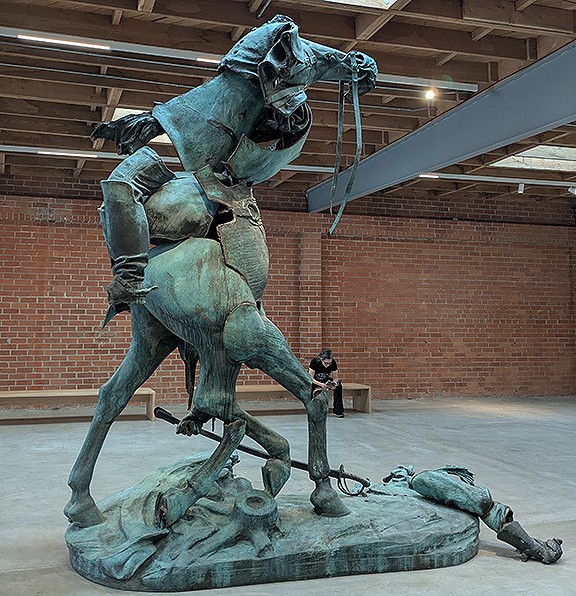
Unmanned Drone (2022) by Kara Walker, a The Brick in East Hollywood, February 2026.
As if to underscore the barbaric, cruel madness of the attack on Iran—the clearest indication yet of the end of Pax Americana, the once painfully slow and now surprisingly rapid decline of US power and supremacy—we have the nation’s capital filled with creepy multi-storied banners of a scowling Trump staring down from various public buildings. He demands to be seen at all times, even while in his ever more obvious dementia he is capriciously tossing away much of the soft power that the United States built up over the decades since WWII (not that I defend US power or supremacy or care about its demise except as a cheerleader).
His focus on his idiotic ballroom, the attempt to take over national culture through seizing the Kennedy Center, and insistence on rewriting (literally whitening) historical narratives in national monuments and the Smithsonian museum assumes everyone’s attention span is as short as his own and everyone is as ignorant as he is. But Trump’s obsession with statues is most telling. He is promoting large monuments of himself, of course, but he also is bringing back Confederate monuments toppled in the 2020 uprisings, and even wants to create a new park in time for this summer’s 250th birthday celebration full of statues of “great Americans” as his 2nd-grade understanding of history deems them.
So the battle is joined from coast to coast as history wars are being openly fought everywhere. In Los Angeles a show closes later this year (on May 3) called “MONUMENTS.” It is in two locations run by the Museum of Contemporary Art, the Geffen Contemporary adjacent to LA’s Japantown, and The Brick in East Hollywood. I went down with Adriana and LisaRuth on a field trip to check out the shows. While there we also stumbled on the Tavares Strachan show “The Day Tomorrow Began” at the LA County Museum of Art (through March 29) which was an exceptional contribution to this whole complicated question of monumentality, representation, audience, meaning, and art.
Kara Walker, an extraordinary artist who has had an amazing show (Fortuna and the Immortality Garden—Machine) running in the free part of the SF MOMA for the past year (where the Rivera Mural sat in the separate gallery along Howard Street), was offered the dismantled giant monument of confederate general Stonewall Jackson to render into something else. And did she ever! Her Unmanned Drone (2022) is a wild, twisted dismembering and re-membering of the man, his horse, and the various limbs and weapons that had been erected to extend his life and that of “The Lost Cause” into an indefinite future, but are now a defigurative apparition condemned to stumble and lurch defeated and unrecognizable through a permanent purgatory of civil war remembrance. But also to announce loudly the revolt that toppled the original, the context of its re-de-configuration, and in this case, to anchor the “MONUMENTS” show at MOCA in Los Angeles.
Walker’s stunning work stands alone at The Brick, and the rest of the show is next to Japantown. There you come face to face with a dozen massive confederate monuments removed from Richmond, Virginia and New Orleans, homeless artifacts after their demolition in the wake of three events described by Carolina A. Miranda in her review in the New York Review of Books (March 12, 2026): “the mass murder of nine Black parishioners by a white supremacist at the Mother Emanuel Church in Charlestown, South Carolina, in 2015; the violent Unite the Right rally two years later, when white nationalists descended on Charlottesville (Virginia) to preserve a monument to [Robert E.] Lee that was slated for removal, resulting in the death of a counterprotester; and the killing of [George] Floyd by a Minneapolis police officer, which sparked protests globally.” At the Geffen the large, often vandalized statues are juxtaposed to contemporary responses by a variety of artists, ranging from a bronzed rendition of Ferguson, Missouri (site of Michael Brown’s murder by police and subsequent uprising in 2014) to a series of portraits, “Stranger Fruit” by NY photographer Jon Henry, of black women with their adult black sons in their arms in the form of the classic Pietá facing across the room a massive Daughters of the Confederacy rendition of their version of it. In the show are graffitied pedestals, the disembodied arm and upright finger taken from the Jefferson Davis monument (the Vindicatrix, aka “Miss Confederacy”) which is tucked in an out-of-the-way corner with a video camera filming it, so it appears as distorted projections in various spots around the exhibit hall, to jarring photos of KKK members in full garb to several moving videos filling up whole rooms, including a subversive remix of Birth of a Nation. Somber bronze statues of Josephus Daniels (a newspaper publisher who fomented the white supremacist massacre and coup against the elected black city government in Wilmington, North Carolina in 1898), and Roger B. Taney, the Supreme Court chief justice who penned the Dred Scott decision, sit impassively along a wall across from dozens of portraits of working class southerners both black and white at the turn of the 20th century.
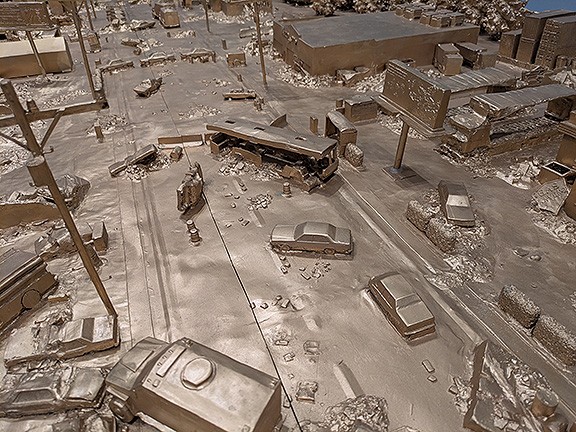
A small detail from Kahlil Robert Irving’s bronze rendition of Ferguson, Missouri.
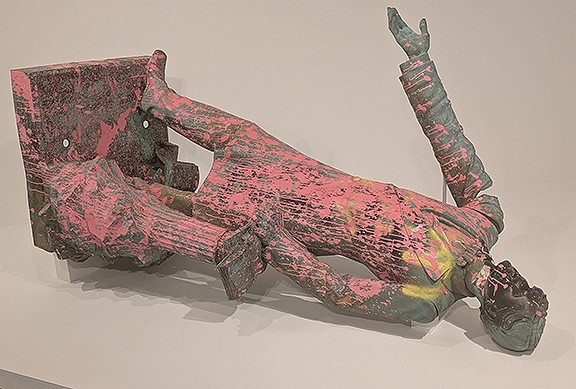
Jefferson Davis, former president of the Confederacy, deposed and graffitied, at the MOCA in LA.
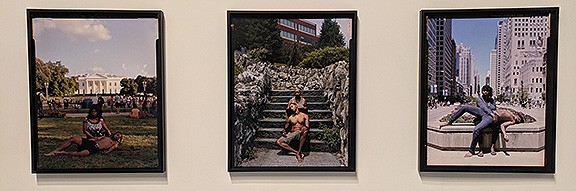
From Jon Henry’s Stranger Fruit series.
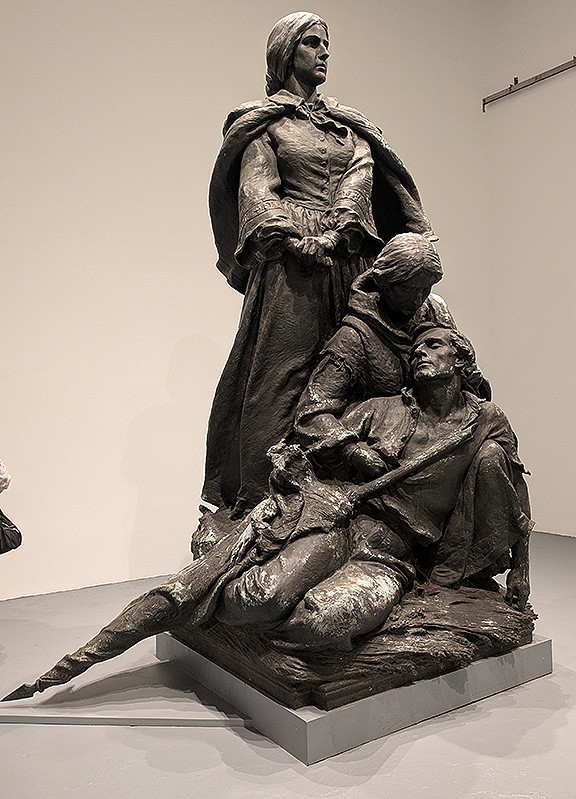
The Daughters of the Confederacy’s Pietá.
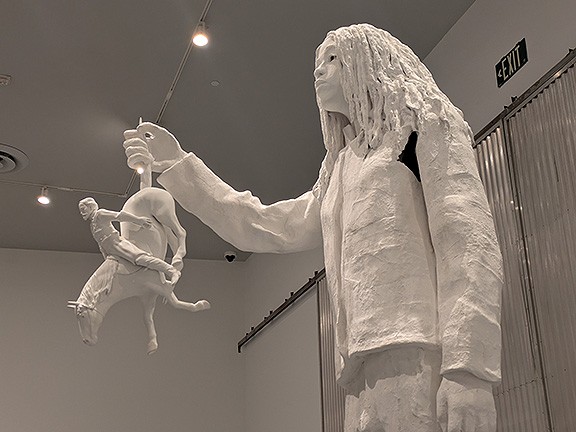
Karon Davis’s Descendant, a plaster rendition of her son Moses dangling a confederate monument, which stands in front of the above Pietá.
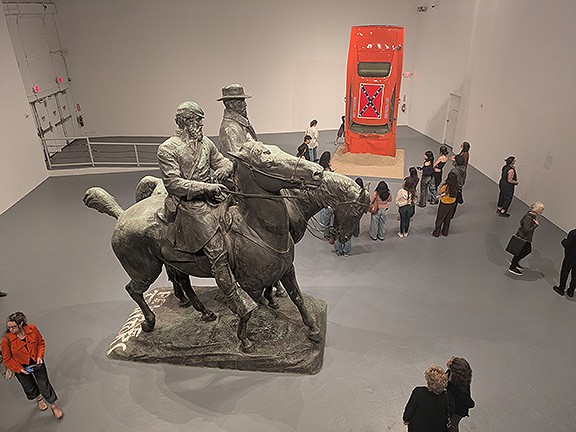
Robert E Lee and Stonewall Jackson, flanked by a Dukes of Hazzard car plunging into the ground.
Seeing the show in early February in Los Angeles felt strange. As Miranda usefully points out, in spite of being a “searing, essential show,” it fails “to make a clearer connection between its subject and the place where the exhibition is being presented.” She goes on to describe how California had its own connections to The Lost Cause, but Miranda missed an opportunity to go further when she repeats the gloss that California was a “free state” and sent gold to the Union. The reality is that Indian slavery was in full effect until the Emancipation Proclamation forced then-Governor Leland Stanford to remove the clauses in the state constitution authorizing that barbarism. But even as a presumably “free state” California courts repeatedly returned Blacks in California to “their owners” and allowed the white claimants to rent out their so-called property and claim their wages as their own. California courts even facilitated the return of dozens of people to chattel slavery in the deep South. Moreover, sailors on merchant ships were considered to have no rights, a condition affirmed much later by an 1897 U.S. Supreme Court decision declaring that the 13th Amendment’s ban on involuntary servitude did not apply to sailors because they were deficient in the full capacity of normal adults! But as Miranda correctly points out California had its share of Confederate monuments and many schools and towns named after Southern heroes (like Fort Bragg on the north coast, named after a notorious Confederate general).
But one has to ask if the show missed something essential by not including works torn down in California during the same period, specifically numerous statues of Junipero Serra, the Catholic priest and “saint” who presided over the establishment of the original chain of missions. In those missions countless thousands of California Indians died of disease, rape, violence, and despair. Serra, who had spent almost two decades in the mountains of central Mexico before coming to Alta California, certainly knew first-hand that the result of forcing indigenous people into Spanish mission life was usually an early death, and often a catastrophic demographic collapse of the local population. But he brought that same model to California in the delusional idea that he was saving souls and fulfilling a prophecy made in the early 1600s by an equally delusional nun in rural Spain. On Juneteenth 2020, weeks after the Floyd murder and subsequent international protest movement had erupted, dozens of protesters converged on Serra statues in San Francisco’s Golden Gate Park, at Mt. Roubidoux in Riverside, and near LA’s historic Olvera Street and took them down.
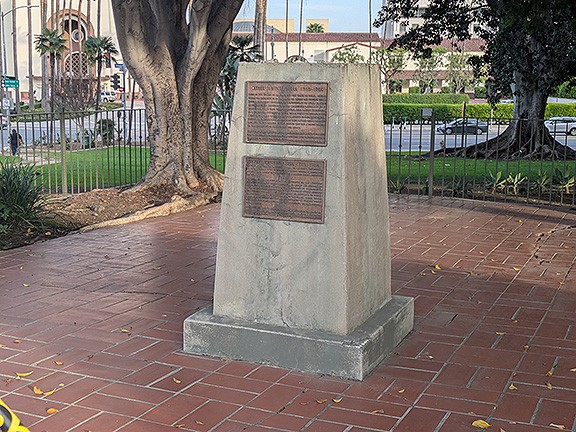
Empty plinth that once held the Serra statue near Olvera Street in LA.
In San Francisco this past year five separate but linked projects sponsored by the Arts Commission set out to rethink monuments taken down or challenged during 2020: Junipero Serra, Ulysses Grant, Francis Scott Key, Columbus (pre-emptively removed by the city itself), and the intact Dewey Monument in Union Square. The Grant monument was taken on by the American Indian Cultural District who are engaged in a larger project called “Mapping Genocide” which has produced a documentary film and various artworks displayed at the SFMOMA—their project has identified dozens of streets and buildings in San Francisco named after 19th century politicians and military officers responsible for Indian genocide, names we see everyday but usually don’t know their history. Fillmore Street in San Francisco has a storied history at the heart of the post-WWII black community, but ironically Millard Fillmore was a racist antebellum President in the 1850s who worked to preserve slavery. That’s just one of many examples.
James Phelan had his name on the street running in front of City College until a couple of years ago when a public campaign got it renamed for Frida Kahlo. Phelan was the mayor from 1897-1901 before being voted out by an angry (white) working class after a major waterfront strike in 1901 that Mayor Phelan worked to defeat. As a child of elite Irish Catholic San Francisco, Phelan embraced an imperialist worldview that was deeply racist, not uncommon for his time, but no less abhorrent for its being so “normal.” As mayor during the first years of the U.S. war against the Philippine Independence movement, after his time in office he spent personal funds to finance war memorial monuments, including the Dewey Monument to the U.S. Navy in Union Square, and the so-called “California Volunteers” monument to the soldiers who slaughtered a half million Filipinos, a statue that still stands at Market and Dolores Streets. You can read about the war criminals who stood by Phelan at the statue’s inauguration a few months after the 1906 earthquake and fire. A year later the statue of Junipero Serra commissioned by Phelan was inaugurated by the Native Sons of the Golden West in Golden Gate Park. (Years later, then California Senator Phelan ran for re-election in 1920 on the slogan “Keep California White”!)
These tawdry origin stories for statues that serve as public monuments ostensibly commemorating and celebrating important people and events in city history turn out to be quite typical. Dan Hicks, a museum curator in England, wrote a scathing account of European plunder and the duty to return stolen artifacts like the Benin Bronzes some years ago in The Brutish Museum. His most recent book, Every Monument Will Fall: A Story of Remembering and Forgetting (Penguin Random House UK: 2025) is a sprawling meditation on the deeper meaning of museum artifacts, public statues, and bronze monuments, especially given that they are so prominent and seemingly permanent in their European and U.S. contexts, whether in public plazas or parks, or carefully kept in curated museum spaces. He usefully points out that most of what passes for historic monuments in our time were built between 1870-1920. My colleague LisaRuth Elliott connected that to the rise of new forms of metalworking and steelmaking that emerged in the early Industrial Revolution, which seems like an important piece of the puzzle given that so many of the men (and they’re almost always white men) enbronzed were the industrialists, militarists, and politicians of the high imperial era (and thus nearly to a person, deeply racist). That holds true for our local statuary even on the west coast of North America, as it turns out. Here’s Hicks:
A movement that normalized dehumanization, mainstreamed debasement… by using not the fake science but culture and art, which ran from the 1870s to the 1920s through the museums, the monuments and the lecture rooms, and hardened across subsequent generations, sometimes brittle and sometimes resilient, a phenomenon of phantasm, spectacle and silencing that endures to the present day. It’s characterized by a certain resemblance to the real, the appearance of fidelity in representation, but a sense of fidelity that emerges purely from duration, from a myth told slowly so as to try to outlast reality. … how about we name it simply militarist realism? (p. 79)
Militarist realism, by which I mean the creation of militarist-colonial conditions under which it could seem impossible to imagine the world otherwise, involved the gradual formation and reinforcement of the borders of the post-emancipation ethnostate across every conceivable form of cultural Whiteness, limits of the imagination patrolled by volunteer reservists, reinforced by museum displays or changes in suffrage… It gave license for virulent structures of ethnonationalist violence at a new scale—a history of militarism… in which culturally defined racial categories came to justify mass killing… (p. 234)
If we are to understand the techniques and tools used by this image of ‘militarist realism’ to reproduce itself over time, then we need to do more than take the work of anthropology, or archaeology, or the museum or the monument as timeless projects… but try to understand how the representation and misrepresentation of ‘others’ was from the start an intergenerational technology of endurance. The fiction was that a statue, a display, or a body of knowledge would be immortal, icons of how cultural Whiteness would outlive dying ‘races’ through technological superiority and civilization. … These monuments, as ideas and images, as objects or subjects, would represent an underpinning cut into the treatment of millions of human beings and human bodies as objects, commodities, chattel, property, currency, at an industrial scale. (p. 244)
Hicks’ analysis brings home the underlying logic of Trumpism’s clutching embrace of statues, especially its willingness to spend millions of dollars to put back monuments to the Confederacy taken down a few years ago, to re-rename military bases for their original Confederate namesakes (while disingenuously claiming they are for newer people who share the same original surname), and so on. Trump is on a personal mission to etch his likeness into the iconography and landscapes of the nation, whether on Mt. Rushmore, on a huge statue, a new oversized Triumphant Arch in DC, the $5 dollar bill, or just with North Korean banners hanging all over the capital. His demand to be displayed and honored rises while his popularity falls—another example of his complete disconnection from reality. But his project has popular support less because of his cult popularity (though that does have a mysterious hold on millions) but because it is a forceful reassertion of the losing cause of white supremacy.
All of these recent efforts, built on the legacy of the ponderous statuary of the Lost Cause and other militarist fantasies, are characteristically serious and self-important to the point of self-satire. Tavares Strachan, the Bahamian artist whose show at the LA County Museum of Art “The Day Tomorrow Began” brilliantly foregrounds a sly sarcasm throughout his multi-room solo show, but also goes well beyond mere monumentality to examine unnoticed public places of encounter as worthy of portrayal, such as the Black barbershop and an uproarious satirical laundromat. His show begins with walls covered in his Encyclopedia of Invisibility, an epic collection of thousands of entries he’s put together from years of following his own curiosity into overlooked and unnoticed and unheralded stories, places, people, and concepts. In his own Hall of Monuments, Strachan has built towering figures in juxtaposition: Winston Churchill and murdered South African freedom fighter Steven Biko; Haitian revolutionary and eventual “emperor” Henri Christophe on his horse reaching for the ceiling while the flipside underneath his horse is Napoleon with his tricorner hat smashed into the museum floor.
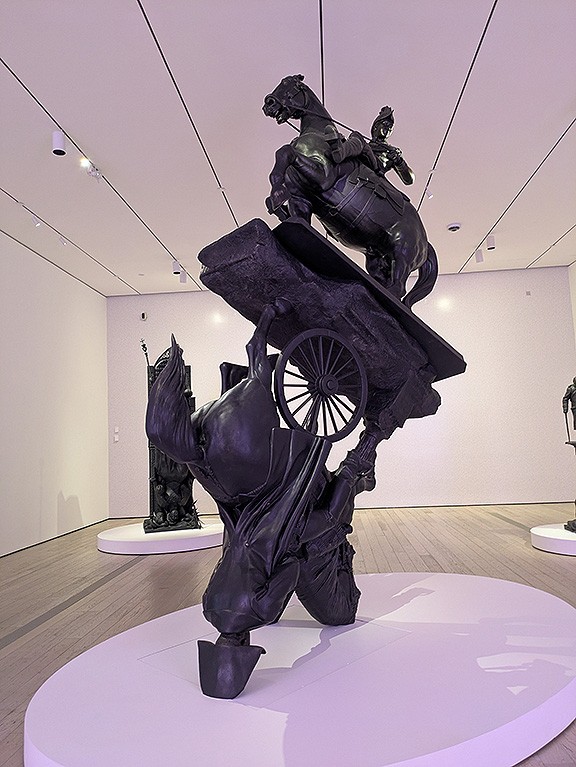
Tavares Strachan’s Christophe and Napoleon
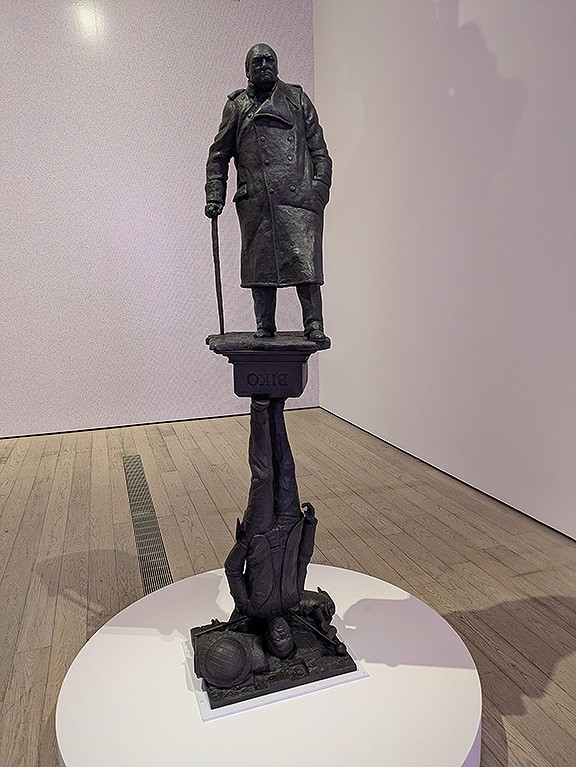
Churchill and Steven Biko
The show was a hilarious rejoinder to this whole Trumpian project, and also in some ways a deeper critique even than the MONUMENTS show was able to mount (limited as it was to the Confederate monuments and responses to them, as good as they were).
Strachan’s work harkens to the creative interventions into historical writing best exemplified in the work of Saidiya Hartmann, like Wayward Lives, Beautiful Experiments: Intimate Histories of Social Upheaval which retells stories of black women in New York’s Harlem in the early 20th century with stunning depth and insight, plumbing a topic with very little of the kinds of source materials traditional historians insist are the only proper way to “do history.” Hicks’ book, in its wide scope, also takes up her work and helps shed light on how to situate it in its boundary-crossing multidisciplinary amplitude:
In the context of the history of enslavement, Hartman offers a kind of literary method of ‘remaking the document, for assembling and composing alternative narratives of Black existence’. Michel-Rolph Trouillot got us to attend to how through such mentions and silencing events become codified: first as sources, then as archives, then as narratives, and then as history. But Hartman goes so much further to show that where there are gaps and erasures in the archival record, the imagination might be put to work in a narrative strategy to tell a new story. Speculative narrative might even jeopardize the status and solidity of historical events, she says, … and rearrange the basic elements of the story in a kind of double gesture: one that strains against the limits of the archive that narrates the past, without ever fully representing it. … a reflection by Hartman on her method, where she described critical fabulation as encompassing ‘speculative history’, ‘close narration’, ‘documentary poetics’, ‘radical narrative’, ‘intimate history’, ‘remaking the document’, ‘errantry’, a series of response to ‘the limits, the lies, the omissions, the fabrications’ of the archive. The purpose is not to give voice to the silenced, but instead to imagine what can’t be verified. It’s an ‘impossible’ form of writing, Hartman says; one that seeks ‘to exceed the limits of the sayable dictated by the archive’. To go beyond what can be represented. (p. 122-123)
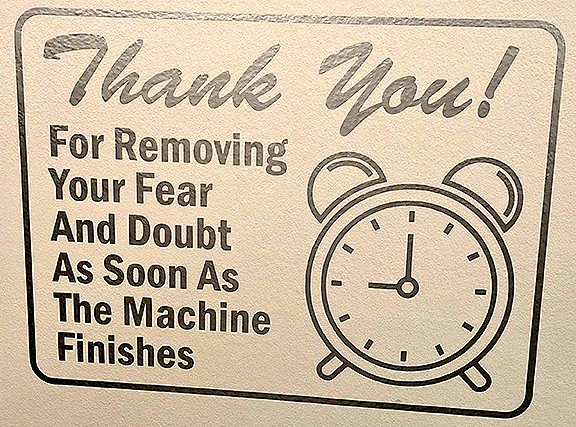
The show at the LACMA, with Strachan’s work at the center, pushes the boundaries of exposition in its own ways. Not only does Strachan playfully and pointedly construct new monuments, and present his own sprawling encyclopedia of overlooked knowledge, he also monumentalizes the banal reality of a laundromat, while lampooning the anodyne admonitions so common to that environment.

Strachan’s Washhouse

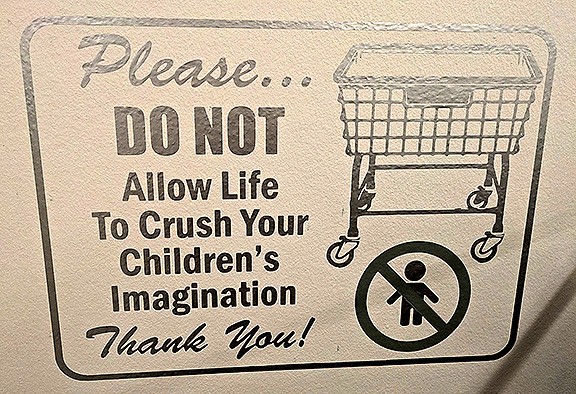
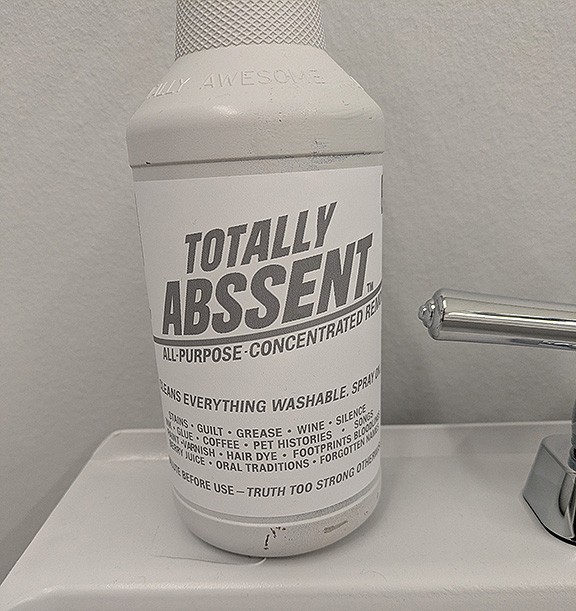
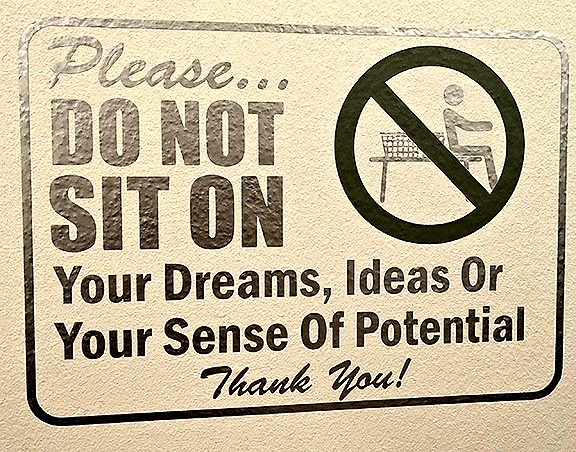
Another artist at LACMA, Jackie Amézquita, interweaves collected soil samples with historic maps to turn a wall into a grid of dried mud squares that reveal a great deal about the built landscape covering the “soil that feeds us” as she titles her remarkable piece.
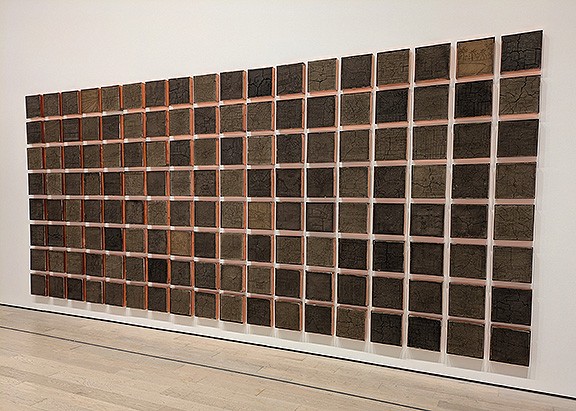
The Soil That Feeds Us
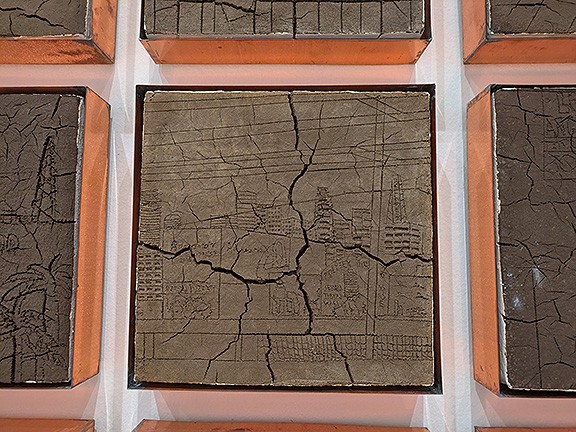
Close-up
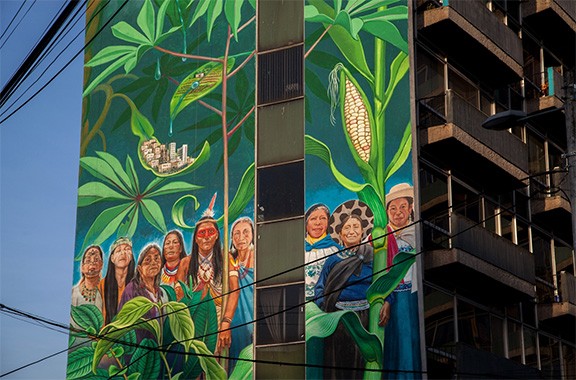
Outside of these examples, my old friend and collaborator Mona Caron has been carrying out a years-long public mural practice that memorializes on a monumental scale overlooked protagonists of history. From water defenders towering over a streetscape in Quito, Ecuador, to a Brazilian herbalist and healer soaring a dozen stories over a major public plaza in Porto Alegre, Brazil, her work directly rebukes the white supremacist monumentality that has dominated public spaces in the global north. But beyond selecting indigenous women for her giant murals, she has also pushed obscure weeds into the foreground, filling multi-storied building walls in New Jersey, the Bay Area, and many other places in North America and Europe with local disregarded plants that survive in the cracks of a concrete-dominated modern world.
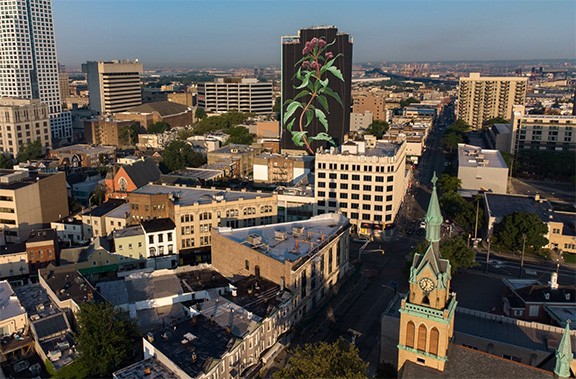
Shauquethqueat’s Eutrochium, in New Jersey!
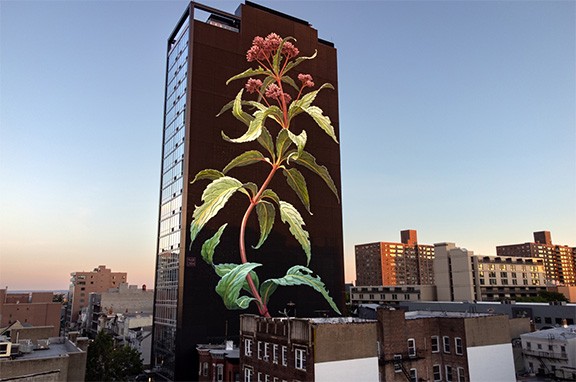
A closer look
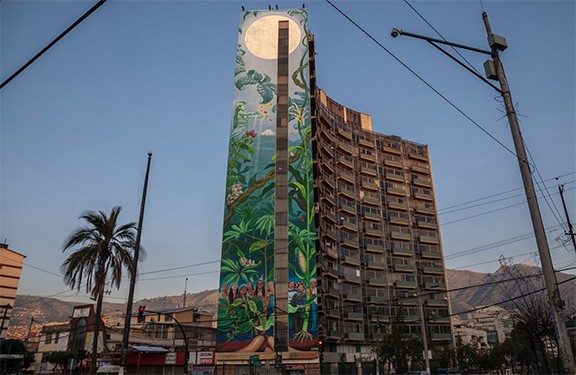
Women Water Defenders in Quito, Ecuador
A closer look
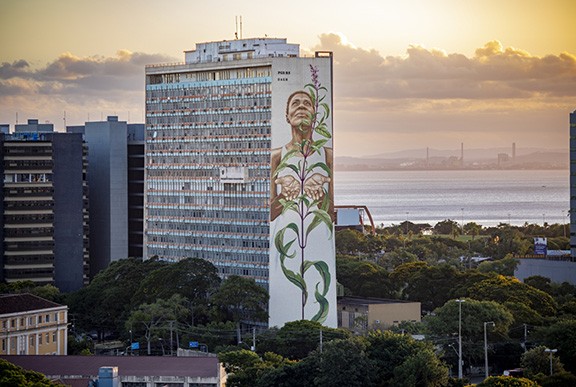
Quebra tudo Abre Caminhos in Porto Alegre, Brazil
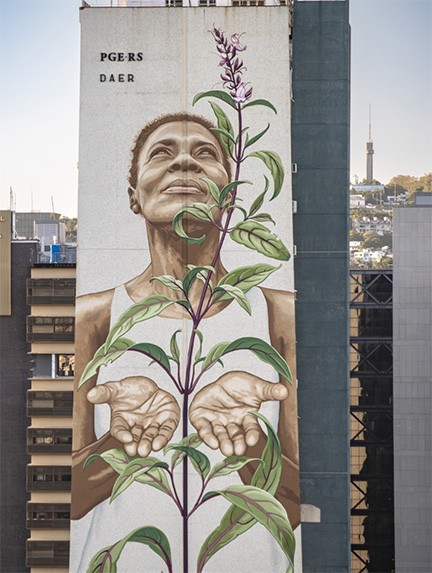
A closer look
Since early 2025, the tidal wave of far-right politics swamping our daily lives has been depressing and enraging. For many it’s been difficult to see the slowly building repudiation that emerged most notably in Los Angeles and then in Minneapolis. Lacking a true opposition political party or movement in the US means that the everyday kindness and mutual aid characteristic of most folks who live here has become the foundation for a rising tide of refusal to go along with the fascist project. The doughy thugs hired from their basement couches and outfitted with lethal weaponry to serve as Trump’s paramilitary troops are already demoralized and confused, clueless to the profound anger their banal brutality has brought forth. That anger still lacks a coherent political voice but we can already be sure it will be heard and won’t be defeated by the surprisingly stupid, petty tyrants struggling to button their camouflaged fatigues and to keep their masks from falling down to reveal the cowardly incels and frightened boys hiding inside.
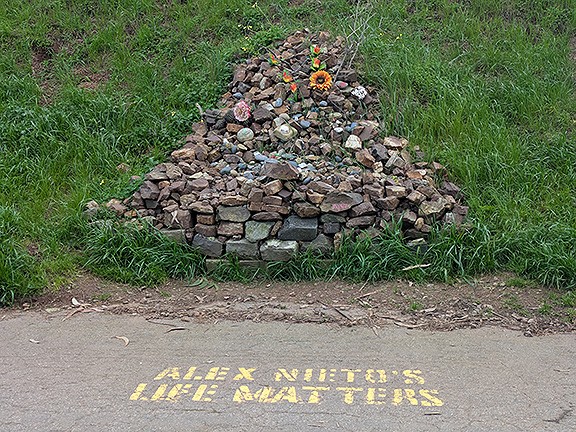
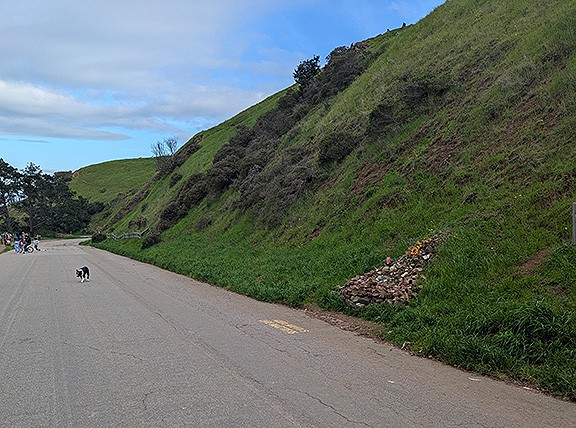
Meanwhile, monuments continue to get made to meet the needs of actual people. Here’s the Alex Nieto memorial on the side of Bernal Heights, not far from where he was murdered by a hail of police bullets in 2014.
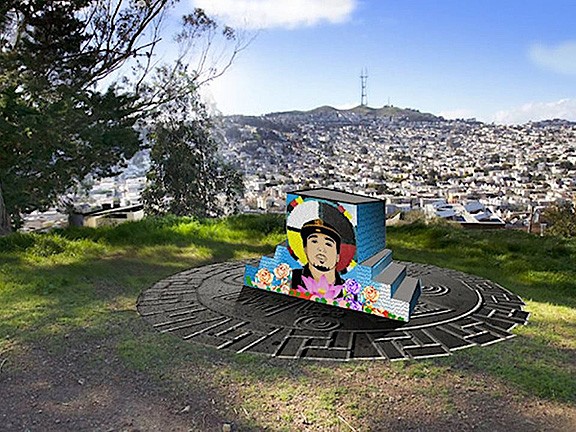
And this is Lucia Ippolito’s mockup of a proposed permanent monument to be built a bit further up the hill, but so far remains unbuilt:
And while we were strafing Caracas and kidnapping Nicolas Maduro and his wife from the capital of Venezuela, it seemed fitting that folks gathered at the monument to the Liberator, Simon Bolivar, in UN Plaza:
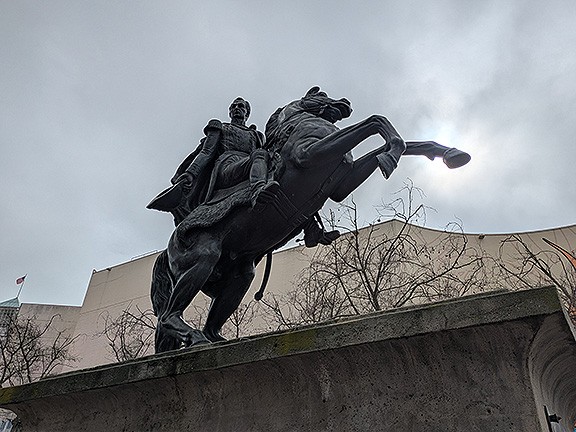
Simon Bolivar statue in UN Plaza.
I’ve been visiting my dad regularly in Millbrae and I get there by bicycle and BART, disembarking at the San Bruno station adjacent to Tanforan Mall. It’s the same site of the old racetrack that was turned into a concentration camp and transfer station for San Francisco’s Japanese population in early 1942. Fittingly, local historians and activists have built a beautiful memorial to the folks who were incarcerated there, every name etched on brass plaques on the back wall, a fine statue of two children and a wooden frame model of the stable size families were housed in.
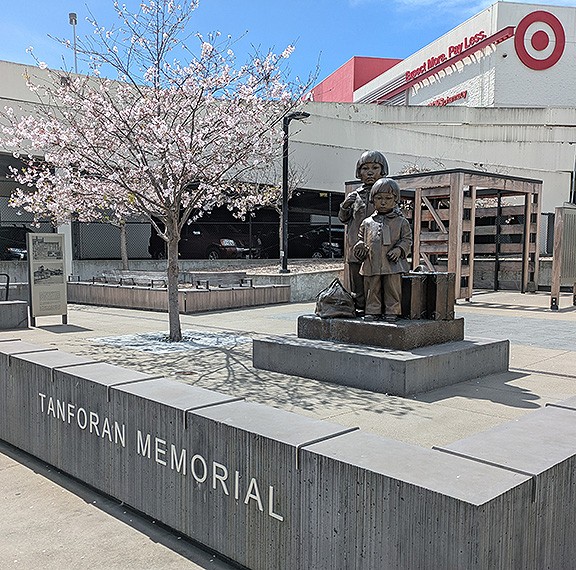
This is the outdoors memorial at San Bruno BART station, inside there are a dozen very well written informative signs explaining the history of Executive Order 9066 and the illegal incarceration of over 120,000 Japanese American citizens during WWII.
On our way to the MOCA Geffen MONUMENTS exhibit we walked through LA’s Japantown and came upon this memorial, which somehow seems a fitting conclusion for this rumination:
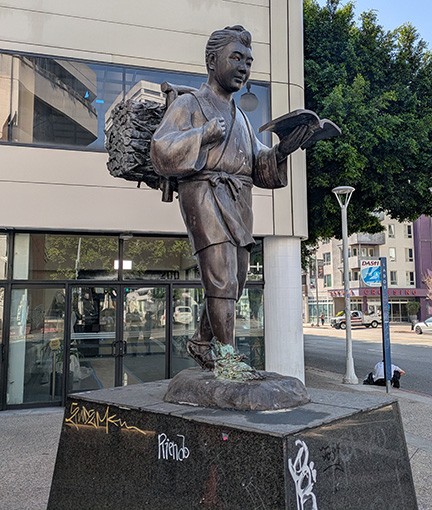
in Los Angeles.
Last word to Dan Hicks:
Any society chooses its heritage by deciding what it wishes to retain. This is about legitimacy, transparency and consent. You can’t keep everything. Everybody knows it’s about choices in the present. Every monument will fall. (p. 406)
Matisse was up to something other than memorializing people in that typically realistic figurative way, but conveys feelings that most monuments simply don’t:
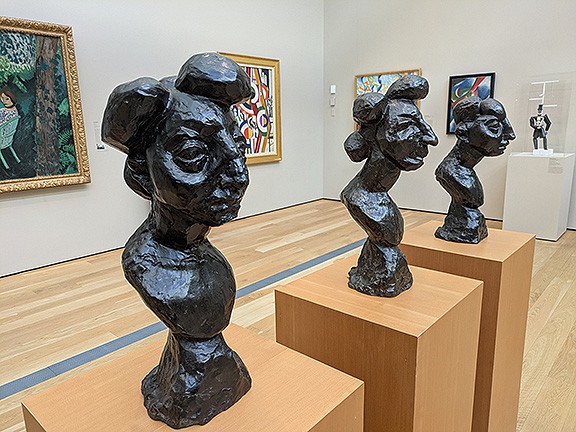
Matisse busts in Los Angeles County Museum of Art.
Leave a Reply