

During the peak tide on November 25, 2026, this art that shows the projected king tide level in 2050 was almost reached! We’re a bit early I guess!
Thanksgiving eve… haven’t blogged hardly at all this year. I realize it’s not only all the things I wrote last time in “I’d Prefer Not To…” but also the dawning realization that every word I write here is taken and fed to the LLMs by who knows how many entities? And for what? Why should I add fresh raw material to the open internet so these disgusting oligarchs and their robots can keep honing their engines of exploitation with my human expression? I have to admit, that kind of thinking has stopped me from writing several times in the past months.
I was also feeling uninspired for all the obvious reasons. Maybe it was the recent repudiations of right-wing assholes that rekindled my willingness to write. Like most thinking humans, I was heartened by the Brazilian re-election of Lula (even though he’s far from what I think we need politically), and I was very enthusiastic about the Student List success in Serbia, though we’ll have to wait and see what it turns into now that they have parliamentary power. The amazing mass movement that erupted in Spanish cities after an 87-year-old woman was evicted (and eventually died) demanding the end of “rentismo” and a ban on owning homes that you don’t live in was so inspiring! Then French youth went off, followed by uprisings in Italy, along with ongoing protests in India, Chile, Colombia, Argentina, Bolivia, etc. And of course the national election results that were a loud rebuke to the fascists in the US were satisfying on that level at least (as most thinking people realize, the Democrats are about 98% certain to fuck it up—the lame duck Democrats are currently rushing to pass BAAJA, which is the Project2025 gutting of the Endangered Species Act, the National Environmental Policy Act, the National Heritage Act, all supposedly to advance the bogus “abundance” agenda to remove regulatory impediments from infrastructure projects—including ICE concentration camps!!). Locally, the billionaires behind Denim Dan and his 24/7 PR operation were able to purchase their desired results in San Francisco politicians and propositions. The execrable Scott Wiener, the ultimate pro-Abundance corporate shill, will represent San Francisco in Congress. It’s a bit jarring to look at the electoral map and realize that such a large part of the city supports these oligarchic assholes and their retrogressive politics. I live in the Mission where it remains reliably “left-wing” fwiw (not that that means much anymore).
I’ve been grinding away on my third stint on the Land Trust board of directors, feeling very frustrated as the organization that we embraced to decommodify our home has become an ever larger office operation with a much larger staff all making six figures. I consider it all too compliant with the ongoing political control of the Mayor’s Office of Housing… the city agency that funded the bulk of our building’s cost and thus holds the ultimate reins when it comes to rent increases and operational procedures. But that story will be told another time.

Welcome to the newest mural in Balmy Alley! La Risa del Maiz.

Credits for the mural.
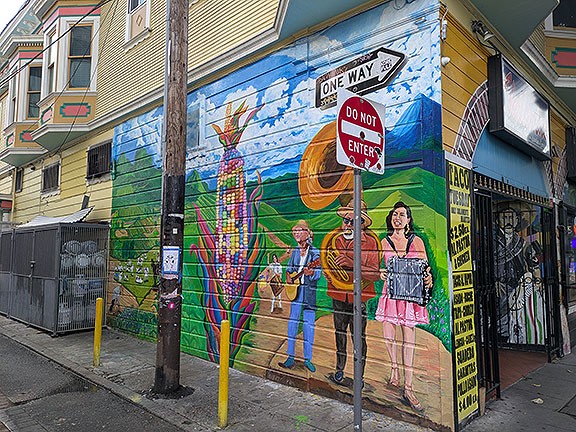
Another angle… regrettably there’s a damn telephone pole in the way!
Since the last time I blogged I was able to move my father out of the rapacious clutches of the private equity overlords who have bought up most of the assisted living and nursing homes in the US and UK. His monthly rent+care bill started in March 2025 at $7,042, went to over $10,000/month in January 2026, and was heading to nearly $12k/month this fall. As my dad said to me, “I’m not dying fast enough!” I imagine an awful lot of people are having that kind of exchange with their aged parents these days. With the help of a friend, I found a great family-run place in the Sunset near Stern Grove and it’s only $6000/month! We can sustain that indefinitely since between social security and his pension, he has almost that much in monthly income. It’s a big relief, and especially since now he’s in a place where there’s always someone around and he is not going to fall or suffer a heart attack and have no one notice for hours (as it would’ve been at the prior place).
I have my granddaughters sleeping over one night every weekend these days too… that’s a great pleasure, though as they get older, smarter, and more assertive, it can be quite challenging. But mostly I love it. Between them and my father, I’m definitely in that weird “sandwich” slot, heading to my own 70th next March (and finally to get my social security going!).
But enough about me. A lot of the reading I’ve been doing over the past year is the stream of new books covering AI and the political and social ramifications of it all. Meanwhile, my wife has become adept at using it for her independent consulting and ghost-writing work, so I have a close-up and personal view of how it can augment a self-employed individual and give them the capacity to do a lot more than they might do on their own. I don’t think the software is going away, but I do think the bubble is finally bursting, and with it, hopefully the leading companies in the industry will fall too. The bizarre religious cultists that run Anthropic and OpenAI and lurk inside most AI companies (all money losers) are repulsive and weird and their instrumentalizing of everyone and everything towards their pro-extinctionist political agenda would be frightening if it wasn’t so obviously ridiculous. Our local Stop AI activists have unfortunately tended to focus on the religious fantasies of these cultists, chanting “stop AI or we’re all going to die!” and other absurdities, rather than targeting AI for what it’s really here to do, upend labor markets and make the human work that remains ever more machine-like. Not to mention reinforcing the worst racist and sexist crap that has been percolating around the internet for years, which LLMs scoop up and regurgitate with alarming predictability—being arithmetically-based word calculators, that’s all they can actually do.
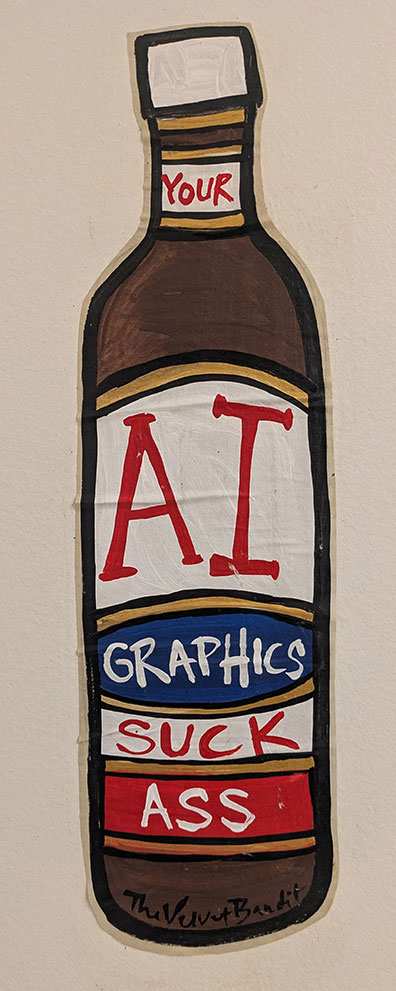
Found in the bathroom at an art gallery in TenderNob.
The recent NVDIA/Jensen Huang spectacle had the effect of kicking the supports out from the already wobbling speculative bubble. The so-called “dead cat bounce” that his reinstatement engendered probably let Trump and his cronies and various associated hangers-on get their money moving during that day of frenzied trading, but it fell apart on day 2 and 3 and there is no reason to believe that they can restart the circular financing merry-go-round fast enough or with enough velocity to re-inflate the stock bubble whose audible hissing has accompanied the bay waters lapping over the city’s shoreline while massive waves violently pound the coast.

About an hour after high tide, bay waters still overlapping the Pier 5 walkway.

Heron’s Head Park was nearly submerged by the high tide. A sign of things to come…
The juxtaposition of oligarchic impunity to the El Niño kelvin wave oceanic heating and larger-than-expected tidal surges are a sharp reminder of the real stakes we’re playing with in a world that maddeningly reproduces itself when the urgent task is to pull the emergency brake and stop this runaway train. The train is not really AI either—it’s the system that is boiling the planet while pretending there’s no way to change course because… “the economy”!
James Bridle in the introduction to his Ways of Being—Animals, Plants, Machines: The Search for a Planetary Intelligence (Picador, FS&G: 2022) makes the obvious point:
… I am sometimes asked when ‘real’ AI will arrive—meaning the era of super-intelligent machines, capable of transcending human abilities and superseding us. When this happens, I often answer: it’s already here. It’s corporations. (p. 8)
His book is a surprising and illuminating rumination on intelligence, technology, and more-than-human nature in all its brilliant specificity. Unlike some of the other writers I’ll discuss here, Bridle seeks a shift in our definition of technology. He brings in the seminal science-fiction writer Ursula Le Guin to bolster his approach:
Technology, understood as our interface with the material world, is that human practice which most closely ties us to our context and our environment. It exemplifies and performs the most central characteristics of ecology: complexity, interrelatedness, interdependence, distribution of control and agency, even a closeness to the earth and the sky; on, under and out of which we fashion our tools. (p. 14) … ‘Technology,’ [Le Guin] wrote, ‘is the active human interface with the material world.’ Its definition, for Le Guin, wasn’t limited to ‘high’ technology, like computers and jet bombers; rather, it referred to anything that was produced by human ingenuity. That included fire, clothing, wheels, knives, clocks, combine harvesters—and paperclips. (p. 13)
Juxtapose this framing with that of eminent historian Jill Lepore in her latest book The Rise and Fall of the Artificial State (Liveright Publishing, WW Norton & Co.: 2026). She chooses a different science fiction writer, Ted Chiang, to illustrate her own argument. She also hilariously touches on the trope of the AI agent tasked with maximizing the production of paper clips, which according to AI doomers would lead a superintelligent AI to destroy everything that stands in its way until absolutely the only thing that remains of Earth when it is done is an infinite number of paperclips:
The rise of the Artificial State is inseparable from the fall of the natural world. The Artificial State is the factory farming of humans, the sorting and segmenting, the isolation and alienation, as humans were becoming to machines what animals had become to humans. (p. 10-11) … As for wiping out an entire species to maximize the making of paper clips, “That is not behavior that we would regard as intelligent in a human being,” Chiang argued. But it is behavior one might expect of a corporation, and not only in the age of the Artificial State. (p. 126) … Humans had to deprive animals of agency—personhood—before they could imagine that robots would do the same to us. For the last four centuries, humans have wiped out or nearly wiped out entire species to maximize the making of, essentially, paper clips: the great auk for pillow feathers, the monk seal for lamp oil, African elephants for ivory piano keys, sea turtles for hair combs. In science fiction, robots annihilate humans, as a species, with the very remorselessness with which humans have hunted and used, eaten, held captive, or destroyed so many other species. Robots are our Ahab, and we the whale. (p. 127)
Nonagenarian George Eastman, still going strong in his tenth decade but knowing he’s not long for the world, analyzes the unfolding changes in humanity against the ubiquitous adoption of digital technologies in The Digital Revolution: Loss of Self and Humanity (Common Notions, Philadelphia: 2026). Like many thinkers on these questions, he wants to define intelligence, consciousness, and technology to help re-center humans and human autonomy and society and politics as the proper place for determining values and making decisions. He brings in Rich Heimann, South Carolina’s first Director of Artificial Intelligence (how many states have created such a position?), who has written:
“Ultimately, AI does not train, perform, or fail like humans because AI is not intelligent. It is a collection of functional simulations, often exceptional simulations. Yet, functionalism is not a cognitive theory. AI systems do not ‘think’ as humans do, and the differences between artificial and biological cognition are not trivial but fundamental. If AI were conscious simply because it replicated functional roles, simulated fire would burn, simulated digestion would nourish, and a mirror would become the person it reflects.”
Eastman continues:
Intelligence, contrary to artificial, is a natural phenomenon, derived from our organic world, that implies awareness, reciprocity, morality, and empathy. Intelligence can be observed in humans, animals, plants and even sea slime, all of which exhibit the ability to react to the world around them in order to preserve their existence. (p. 169) … Considering the Venus flytrap and sea slime, trees and primates, I encourage you to join me in broadening the definition of consciousness: as a sequence of adaptive reactions built into biochemical organisms and biochemical processes.
But the problem, which Eastman spends a good deal of time trying to explain, is that the nature of the human brain itself is under assault by the digital revolution. Elsewhere he identifies how neuroplasticity (which he is academically qualified to talk about) means that brain synapses are “re-wiring” themselves in response to the half awake hypnotic state induced by the endless stimulation of online media, making it more likely that if you’re a child you will show signs of ADD or ADHD, and if you’re an adult, you’ll find it harder to focus and read longer, in-depth hard copy books and articles. But even more deeply, you’ll begin to think like an algorithm.
Algorithm-based devices and programs facilitate binary and algorithmic patterns of thinking. This results in the unconscious, subliminal conditioning by the digital media creating compliant pawns of the powerful business interests moderating our digital world. This algorithmic thinking, combined with the evolutionary traits and primitive drives that underlie human behavior, suggests deeper social, economic, and cultural changes than being simply another variant of capitalism. (p. 114)
James Bridle makes a parallel argument in Ways of Being:
Ever since the development of digital computers, we have shaped the world in their image. In particular, they have shaped our idea of truth and knowledge as being that which is calculable. Only that which is calculable is knowable, and so our ability to think with machines beyond our own experience, to imagine other ways of being with and alongside them, is desperately limited. This fundamentalist faith in computability is both violent and destructive: it bullies into little boxes what it can and erases what it can’t. In economics, it attributes value only to what it can count; in the social sciences it recognizes only what it can map and represent; in psychology it gives meaning only to our own experience and denies that of unknowable, incalculable others. It brutalizes the world, while blinding us to what we don’t even realize we don’t know. (p.177)
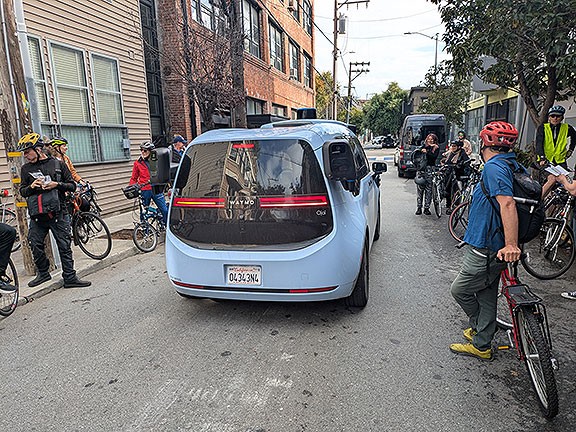
Robot car halts, confused, amidst a bicycle tour we were conducting on Surveillance in Plain View… we had just visited the parking lot where these robot cars are stored since they too are 24/7 surveillance devices.
Trevor Paglen has spent years analyzing military mysteries around the U.S. and the world, creating haunting artistic interventions that raise questions most people would rather leave under the rug. His latest slim volume is How to See Like a Machine (Verso Books: 2026) and it’s a penetrating look at the ways machines are looking at us, but more than that, it’s an examination of how images, having “gone digital,” are no longer functioning as things we look at, but are more often “digital triggers” out of our field of vision entirely. Digital images can be read by machines without ever becoming a photo or video, comprised as they are of 0s and 1s and code. And as Paglen argues
If the postwar media landscape was characterized by spectacle, and the late twentieth and early twenty-first century by an age of surveillance, then we are entering a new phase. One marked by affective computing, machine-learning-enabled optimization, neuroscience, and cognitive psychology. A mediascape that has little use for distinctions between real and fake, signifier and signified. That assumes no distinction between perception and reality, even as it attempts to intervene as directly as possible into the brains and emotional makeup of its experiencers. (p. 74) … The post-AI world of visual culture does not work in quite the same ways as the society of the spectacle or the surveillance society but, rather, folds them both into another period. But these new forms of image-making and writing do in fact “work,” just not in ways we are accustomed to thinking about visual culture. Instead of understanding images as representations, signs, allegories, or metaphors, we can think about them as “activations”—stimuli that trigger automated, preconscious, or affective responses. The critical move comes from shifting our questions away from “What does this image say?” to “What does this image do?” … It’s using a logic of automation, quality control, surveillance, and targeting—it “works” precisely because its interpretive algorithm is designed to collapse the complexities of the world into discrete categories that conform to the logic of commodities, policing, and warfare. (p. 142) … Understanding visual culture in the age of AI requires moving beyond human-centric semiotic frameworks toward recognizing images as triggers embedded in economic, industrial, political, juridical, and neurological circuits. They activate processes, extract value, optimize responses, and reshape reality through the malleable substrate of human perception. (p. 147)
While I’m sure there’s truth here, and that plenty of people are in some kind of quasi-hypnotic state that makes them deeply susceptible to the shopping prompts coming their way from Amazon, Netflix, or Google, I also think most people remain skeptical of or even hostile to advertising they are forced to see. If we can take anything from the surprising repudiation of the Tech Oligarchy in the recent election (and the rejection of their pellmell expansion of data centers), it’s that all this manipulative and subliminal propaganda and Manchurian Candidate programming isn’t working as expected. The behaviorist fantasy that people can be programmed or nudged into doing what the Lords of Technology decide they should (or more prosaically, what the algorithm-based recommendation suggests to them) is wildly overstated in my humble opinion (unsubstantiated by any studies or metrics). It may be that the spell has broken and, like the neo-Luddites who staged their Summer of Ludd last year in New York City, there is a (re)turn to the analog, to face-to-face human life, to the messy, complicated, contradictory, but vital space of real society, and a turn away from the endless instructions imposed by the owners of the digital technosphere.
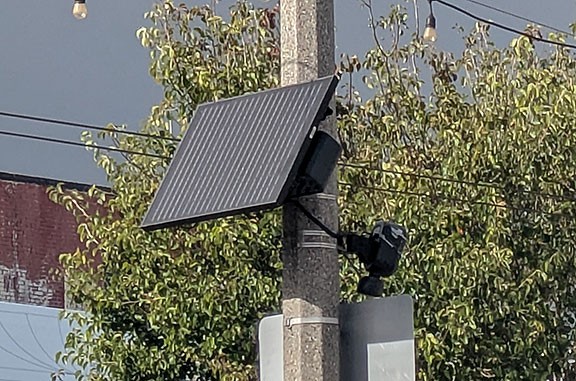
The much reviled and ever more ubiquitous Floc cameras, constantly feeding license plates and photographs in the surveillance state’s operations.
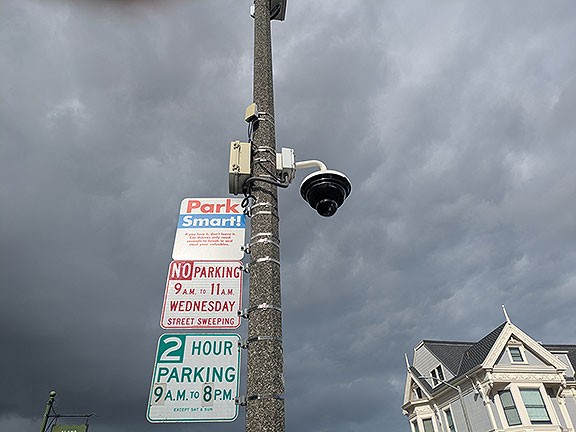
Just another random camera on a street post near Alamo Square.
Cory Doctorow, a great science fiction writer in addition to being a reliably sharp pundit on all things techno, came out with his latest this year, The Reverse Centaur’s Guide to Life After AI: How to Think About Artificial Intelligence Before It’s Too Late (Farrar, Strauss and Giroux: 2026). He’s more open-minded and optimistic about our ongoing involvement with new technologies, but he says it well at the end of his slim volume:
… we are forced to take sides as either “anti-AI” or “pro-AI.” It’s fine to be “anti-AI bubble,” but it’s pretty silly to be “anti-statistical analysis” and “anti-machine learning” and “anti-automated inference.” Long after the bubble is gone, many of these tools will recede to the status of boring utilities, nurtured by open-source weirdos and a few ambitious startups… That thing is this: the future is up for grabs. It is not inevitable. AI isn’t a genie that can’t be put back into a bottle. How we use AI is up to us. Whether we use AI is up to us. The future can be ours, if we never stop remembering that the most important fact about a technology isn’t what it does, it’s who it does it for, and who it does it to. (p. 220, 222)
The next part of this discussion will turn to exactly these questions. Who is this technology designed to work for, and what is it doing on their behalf to the rest of us? Stay tuned.
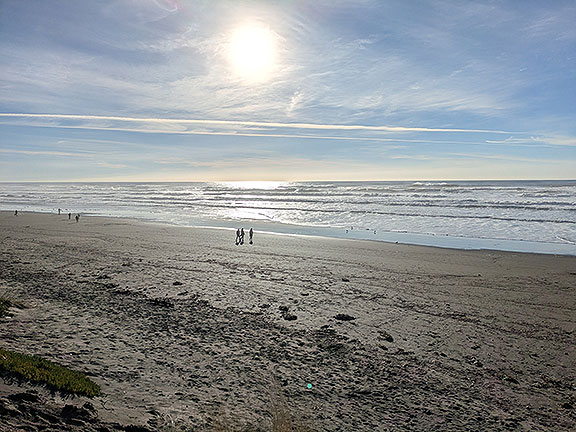
Ocean Beach the day after being hit by massive, violent waves and extraordinary high tides. It was summer in November!
p.s. for a great conversation on related topics, check out Paris Marx’s Tech Won’t Save Us podcast here.






Leave a Reply