Recent Posts
-
I’d Prefer Not To . . .
July 13, 2026
-
Monumental Instability, or War of the Memorials
March 22, 2026
-
Yes, There IS a Future!
December 26, 2025
-
Real Crimes and the Coming Violence
September 6, 2025
-
Whither Modern Life?
June 27, 2025
-
What the Hell
June 18, 2025
-
As Darkness Engulfs Us
April 6, 2025
-
AI, Risk, and Work
January 17, 2025
-
“Things Are in the Saddle, and Ride Mankind”
December 29, 2024
-
Forgotten Futures in Seattle
December 12, 2024
|
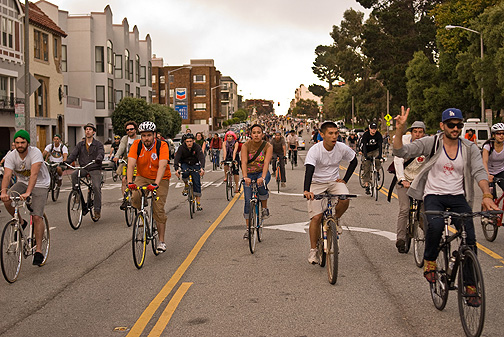
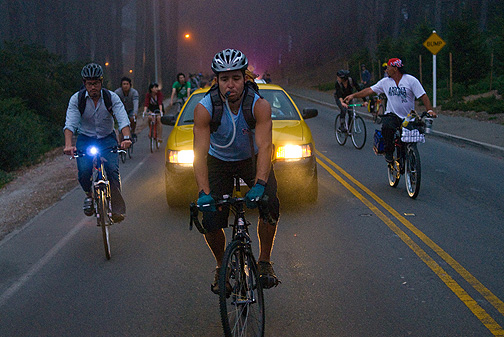
A weird and exhilarating Critical Mass last Friday started a fantastic and busy weekend of fun… The Committee for Full Enjoyment put out a new flyer (pdf) commenting on how little things have changed after 16 years of riding in Critical Mass. Here’s a couple of images that Adam Aufdencamp shot, one in the Marina and another as we were climbing the very steep and long Presidio hill in deep fog… places we’ve never been on Critical Mass. (Lately it’s been great how much we’ve found our way to new spots in the city, but this past Friday was frustrating because whoever was in front never stopped until an hour into the ride, having left hundreds of riders far behind, many of whom bailed.)
The big Slow Food Nation event went off better than anyone expected. I volunteered to work at the Food For Thought discussion on Saturday afternoon, featuring all the big names of the new food politics: Carlo Petrini, founder of Slow Food, Alice Waters, Michael Pollan, Eric Schlosser, Vandana Shiva, and Wendell Berry. I got to hear their speeches, and generally I was quite impressed. I jotted a few notes… Eric Schlosser (Fast Food Nation, a great book) followed Wendell Berry with a pointed call to bring food workers to the table. (The event’s slogan was “Come to the Table.”) He emphasized how poor most food workers are, and how excluded they are from the focus on taste, conviviality, gardening, etc. Following Wendell Berry was fitting, since one of Berry’s main arguments for decades has been to repopulate the countryside, re-establish an honorable and adequately rewarded life for farming, and radically decentralize food production.
Continue reading Living Well Now
Obama and the Alaskan Nut-job governor… how to decide?… let’s see, Obama is FOR “clean” coal (an oxymoron of the first degree) and “safe” nuclear power (another one)… the Alaskan will be off her rocker FOR drilling, warring, babymaking, suppressing dissent (oops, wait, Obama will probably be for suppressing dissent too, but he won’t have to do much because the broad American pwogwessive (non)movement will paralyze itself waiting for Him to fix everything)… would we prefer a blowhard corporate shill with an unknown but vociferous female ideologue of the crazy right, or… an articulate proponent of American power, elected to restore legitimacy to a highly illegitimate and dysfunctional political and economic system? (with an old windbag egomaniac, Senator “Chemicals & Credit Cards,” as his sidekick)… Dontcha just love American presidential politics?
I would prefer to hear the hesitant and calibrated rationalizations of Obama, I admit, but only because it’s more interesting to see how that wing of Capital tries to manage the unfolding crises, NOT because I think he’ll be “good” for anyone or anything that I care about… “less bad” maybe, but only maybe… And that energy policy based on coal and nuclear? That’s a serious nightmare and will require very substantial mobilization to resist its insane implementation, so start your (anti)engines…
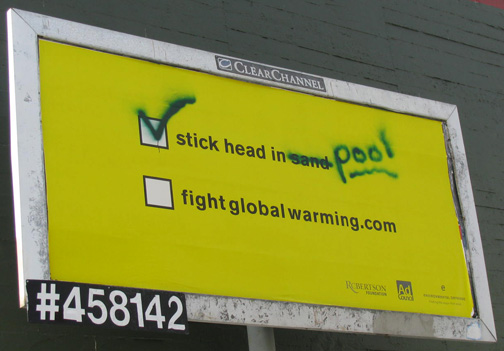
Yah, let’s just jump in the pool and fuggedaboudit… (I really hated this billboard campaign, and find this an appropriately cynical riposte.) But I’ve been living in my usual ecologically compromised-but-thinking-about-it way… Here’s a photo I just took from the top of Twin Peaks yesterday, with a water bottle I got when I volunteered on the Victory Garden at Slow Food Nation (open today at Civic Center and Fort Mason):
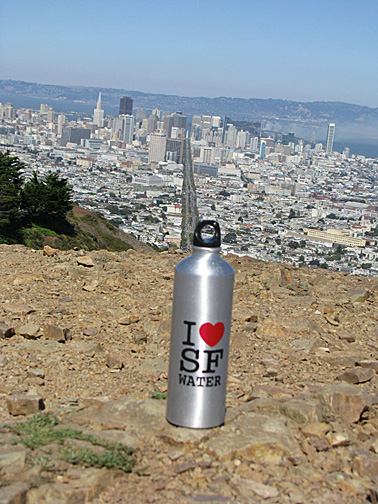
There’s a nice booth at the Slow Food Nation pavilion in Civic Center to “Reclaim The Tap” decorated with dozens of discarded plastic water bottles. I’m very enthusiastic about San Francisco tap water, and public water supplies in general. It’s one of the great stealth privatizations of our era, the creeping paranoia that has infected so many people to make them think that clean, drinking water from the tap is somehow suspect and unhealthy… thus they buy ridiculous quantities of small containers that hold… tap water (most of the time!)…
Continue reading Eco Mots
Dimitri Orlov, whose book “Reinventing Collapse” I mentioned in the last post, has a very illuminating blog post out explaining the events in George, Abkhazia and South Ossetia in a way that you just can’t get from all the propaganda organs we’re normally subjected to… I also recommend Asia Times where there’s been a lot of good coverage from a variety of angles. Amy Goodman interviews Colonel Gardiner about it yesterday, also interesting, and he said he figured the Russians had planned for a U.S. intervention and had made it clear they’d go all the way to tactical nuclear weapons if the U.S. sent in military units to defend Georgia’s assault on South Ossetia. Nothing to worry about! Just keep your eyes on the Olympics!
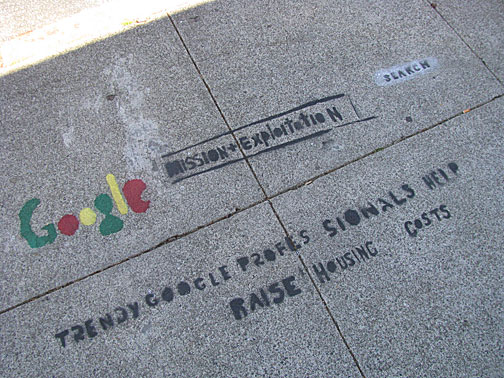
At 18th and Dolores in front of the cafe where the Google shuttle stops daily, someone has painted this on the ground. Recently Carol Lloyd in the SF Comical wrote about the effect of googlers on SF real estate, which might have given impetus for this…
I realize I have been slipping again, now that I’m back in my daily life in San Francisco. It’s not that I wouldn’t love to have the time to ponder and post at least weekly, but I’m spending about 40+ hours a week on the Shaping SF wiki, which we’ve decided to roll out to the public by October 15. (That many hours on computing purposefully makes it reeeeeaaaallly hard to blog… just sayin’.) I’m experiencing some layers of deja vu as I once again plow through all this familiar material that I knew SO well 10 years ago… yep, it’s been 10 years since the original version rolled out (slightly more, Jan 98)… I’ve also been enjoying the new life that comes with Adriana having moved in during the summer. So, all things considered, I’m not as available as I’d like to be for blogging…
Oddly enough I was offered an online radio show, 13 1-hour slots as a pilot program, but it turned out to be one of those “deals” where I would have to find a sponsor, or come up with $7K, neither of which interests me. I’m also facing the prospect of launching a new magazine if I can develop a coherent enough editorial philosophy. Part of me would be delighted to do another magazine, another part of me thinks, “why?”… been there, done that, though not as a “job”… but then I’m still quite happily avoiding anything approaching a regular job, which feels like the basic minimum to me now after so many years of freedom. My income is way down, but my expenses are too, so it’s ok so far…
I have a number of local appearances coming up:
This weekend I’ll be at the San Francisco Writing for Change Conference, speaking at 11 a.m. on Saturday, on Nowtopia and the writing process that helped bring it about. Next Thursday I’ll be presenting at The Abundance League, a charming group of folks who are trying to shift paradigms in ways that I’m enthused about. And then on Saturday the 233rd I’ll be giving a labor history tour to some visiting Egyptian labor reps during the day, and giving a Nowtopia reading at 7 pm at Red Hill Books on Bernal Heights.
Continue reading Pot-purring
|
Hidden San Francisco 2nd EDITION!
NEW 2nd EDITION NOW AVAILABLE!
Buy one here
(Pluto Press, Spring 2025)
|