Recent Posts
-
I’d Prefer Not To . . .
July 13, 2026
-
Monumental Instability, or War of the Memorials
March 22, 2026
-
Yes, There IS a Future!
December 26, 2025
-
Real Crimes and the Coming Violence
September 6, 2025
-
Whither Modern Life?
June 27, 2025
-
What the Hell
June 18, 2025
-
As Darkness Engulfs Us
April 6, 2025
-
AI, Risk, and Work
January 17, 2025
-
“Things Are in the Saddle, and Ride Mankind”
December 29, 2024
-
Forgotten Futures in Seattle
December 12, 2024
|
I’ve been working on other things, thus dropped the blog-ball a bit lately… one reason is I’ve actually been employed to write 3 blog posts a month over at sf.streetsblog.org, so that’ll get in the way of putting things here. (The Jane Martin piece was the first one.) I agreed that I might re-post some things here after two weeks, but here’s the latest one I did for them on depaving and history.
The REALLY BIG NEWS is that the long-promised Shaping San Francisco wiki is up and running and ready to visit! It’s at FoundSF.org, which we’ve renamed it, in light of our new partnership (not quite signed yet) with the San Francisco Museum and Historical Society. I also posted the Spring Bike Tour calendar in case anyone is waiting for that. And I’m trying to finalize the March-May Talks series, overcoming a number of glitches… will post that here soon.
I’m getting out of town this Friday, heading to Belem, Brazil for the World Social Forum, and when I get back on Feb. 4, I will only get up again the next morning to head to Los Angeles where I have a bunch of Nowtopia appearances lined up til I finally come home late on Feb. 9.
Meanwhile, the weather here in San Francisco, while I was expecting to be indoors continuously, has been eerily summer-like. Here’s some shots I took at random last Saturday, late in the day, as I rode over to the lower Haight. First a couple of shots of Dolores Park, nowadays chock full of young hipsters whenever the weather is suitable…
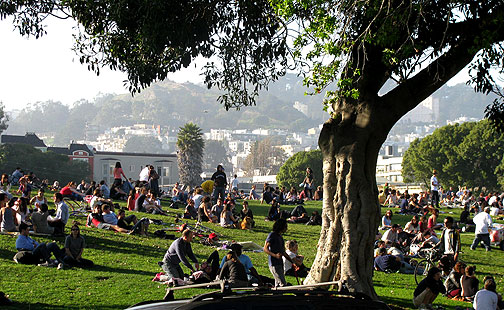 Dolores Park, January 17 09, wintery light, summery air, just north of 19th Street. 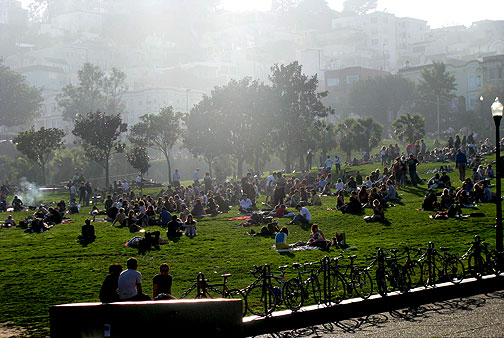 Winter light pours over Liberty Hill onto sunbathing denizens on the slopes above 19th Street in Dolores Park, Jan. 17, 2009. After that I ended up over at Alamo Square and took this iconic photo, happily with humans in it for a change, followed by a strange look at City Hall due to the new architectural landmarks that sprouted behind it in the past few years.
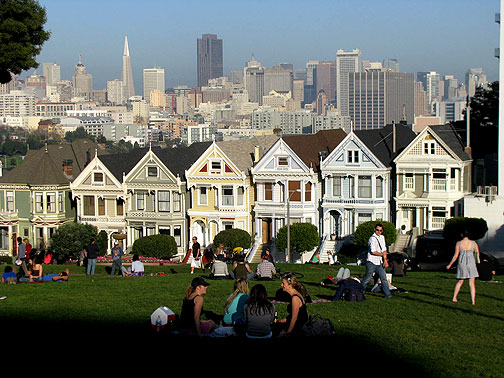 The most typical SF photo... Alamo Square towards Downtown. 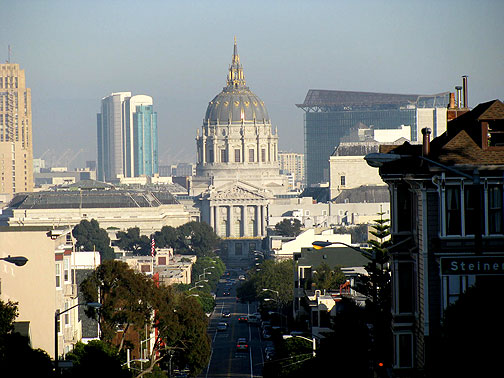 SF City Hall from Fulton Street next to Alamo Square. Federal Bldg to right and new turquoise hotel at 5th and Howard to left. Another task on my plate is to finish a rewrite on an article I’ve been collaborating with Francesca on, for Antipode magazine, called “Nowtopia: Strategic Exodus?” The new writing has to address the “virtual spine of the commons” as I dubbed it in the book, the net, but also networking more broadly. On my way to the World Social Forum, I’m acutely aware of what an abundance of writing and thinking is going on covering the broad topic of networking politics. A couple of interesting articles I read were Social Movements 2.0 by Brendan Smith, Tim Costello & Jeremy Brecher, and The Alternative’s Alternative by Evgeny Morozov. Smith and Costello spoke at a recent Networking Politics conference I attended at Berkeley, and I really appreciated their argument, most of which is reprised in this piece at the Nation. A key to their ambivalent embrace of new online networks is that so far, it’s easy enough to get huge numbers of people to sign petitions and donate money, but really rare to translate such behaviors “into solidarity built on trust and a willingness to take economic or physical risk on another’s behalf.”
“We’re drawing closer to the point where the majority of online tools are so simple that technical experts are beginning to fade into the background. The web is no longer the exclusive dominion of the young and highly educated, and as this trend continues it will allow social movements to cheaply and easily reach out to increasingly diverse constituencies.”
But along with these transformations they correctly note that existing organizations, often quite hierarchical and top-down, will have to cede control to self-organizing individuals. I recall ten years ago when I was working on the first iteration of the ILWU website (they later hired some big firm to do a revamp) there was a great deal of confusion and nervousness about how to present the union on-line. At the time some union leaders were quite resistant to even including the union’s constitution on line, and to this day, they are hostile to an open forum where members can speak to each other directly on the union’s official site. As the authors put it: “The destruction of hierarchies online means that top-down organizations will face increasing pressure from members to permit more rank-and-file debate and input. This is a healthy process and a long time in coming… Organizations that resist this trend will become increasingly irrelevant online and offline.”
Continue reading The Webs We Weave
Feeling the heaviness of Oscar Grant, murdered by a BART cop a couple of days ago. Over in Oakland, at the Fruitvale BART station, some kind of ruckus occurred, and in the video clips below, you can see it unfold. After the police had corralled several youth, one was squirming facedown and a cop tried to suppress his movement, after which he stands up, unholsters his gun and shoots Grant in the back, killing him. Unbelievable. But real.
http://www.youtube.com/watch?v=aXAETrZghn0
http://www.youtube.com/watch?v=tgzNBpjCNX8
This kind of behavior, ostensibly to enforce “security,” is parallel (on a small scale) to the insane barbarism of Israel’s assault on the Palestinians of Gaza. Wildly disproportionate violence is inflicted to protect the “security” of mass society. Lots of people I know are sick about Israel’s criminality, and watching this video of a police murdering a kid in Oakland brought it all home to me.
I grew up in Oakland from 1967-1974 and I have seen a lot of this kind of “police action” over the years, though not often leading to cold-blooded murder. I’ve also had the shit beaten out of me by criminal thugs, so I’m not oblivious to the fear and loathing that can erupt suddenly and for no apparent reason on the streets, in the trains, wherever. When it does it’s easy to wish for a cop to save you. But the violence that sits just beneath the thin veneer of “civilization” is as extreme, and to understand the day-to-day anger and violence that erupts so unexpectedly one has to look at the deeper violence of this society: the matter-of-fact use of aerial bombardment as a tool of foreign policy, the intensely armed presence of police inflicting steady harassment and intimidation in neighborhoods “of color” every day, the absurd levels of incarceration, etc. ad nauseum.
I just finished reading “Framing the Black Panthers: The Spectacular Rise of a Black Power Icon” by Jane Rhodes. This is a masterful work, providing a great deal of detail on the events that make up the history of the Black Panthers, especially in Oakland and San Francisco during the 1967-1972 period. But even more crucial almost 40 years later is her fantastic “reading” of the media coverage at the time, and subsequent to events. The individuals in the Panthers worked hard to gain attention via newspapers and television, and succeeded beyond anyone’s imagination, burning into the cultural landscape a phalanx of black militants garbed in black berets, leather jackets, opaque sunglasses, and wielding rifles and shotguns in a theatricalized expression of Black Militancy. Not that their guns were mere props. They were used on many occasions, since the deeper story involves intense police harassment up to and including open assault with massive firepower. Rhodes is at her best in the conclusion where she draws out the critical historical thinking that does not try to glorify the Black Panthers, or excuse or deny their occasionally anti-social behavior, but seeks to place them in their own historic agency and context.
“To call the Black Panther Party a “media-made” movement is too easy; it assigns the power of representation to media institutions rather than their subjects. This assertion ignores the dialogic relationship–the interdependence–between media producers and media subjects and erases individual and group agency. Rather, we might see the great power of the Black Panthers in their ability to create, manipulate, and subvert mass culture… The Panthers weren’t invented by the media–Bobby Seale, Huey Newton, Eldridge Cleaver, David Hilliard, Kathleen Cleaver, Fred Hampton, and a handful of other actors invented themselves and delivered the goods to the mass media.
“The cultural matrix of the black power movement, which integrated fashion, soul music, street theater, underground journalism, African spirituality, and urban vernacular, disrupted basic assumptions about how politics is conducted. For many observers, then, the Black Panthers inhabited a hyperreal state in which it was unclear whether the meaning they embodied was superseded or replaced by the signs, symbols, and rhetoric that swirled around them. This lent credibility to the idea that there was nothing behind their image but Oz-like wizardry. The Panthers’ very materialist perspective argued otherwise–that it was their claims of race, class, and gender prejudice, not cultural context, that encouraged most elites to deny their importance.”
I’ve always felt a peculiar connection to the Black Panthers, perhaps because I grew up very near to their stomping grounds in North Oakland. I remember well being afraid to go to Bushrod Park (where the surviving Panthers held a 30th anniversary reunion in 1996), a place that I was sure I would be attacked. But I was attacked on my elementary schoolyard not far from there, albeit in a harmless way (spit in the face, stolen baseball mitt and bat, that sort of thing); I also spent countless hours shooting baskets with lots of guys, mostly black, at St. Augustine’s on Alcatraz while I was age 11-14, and in one memorable afternoon I was playing one-on-one with a guy who must’ve been 17 and had me laughing so hard I almost fell over. I was wearing some cutoff jeans that my mother had patched with some black patches on the worn-out rear, and this guy (who I was holding my own with for a while, even though he had 6-8 inches on me) started a whole legend about how I was the leader of the infamous Black Patches, and as he spun the story full of allusions to recent events involving the Panthers I fell apart and couldn’t keep playing, helpless with mirth.
Continue reading Death and Insecurity
I’m beginning to write for a new local effort, sf.streetsblog.org, but tonight, the night before the big debut, I cannot log in… so I’m going to post my piece here, having failed to blog for a while…
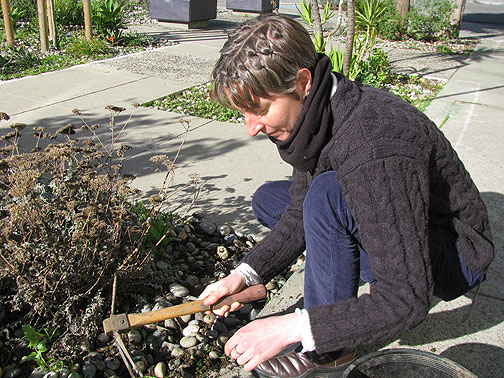 Jane Martin, hands in soil.
Jane Martin is a force of nature. A longtime resident of San Francisco’s Mission District, a licensed architect, and an avid gardener, Martin is the founder of PlantSF, an informational website dedicated to reconfiguring the design and use of urban spaces, primarily sidewalks and to a lesser extent, residential streets. PlantSF started in 2004 after Martin had spent considerable effort establishing a sidewalk garden in front of her then-home on Shotwell between 17th and 18th Streets.
“Before I thought to organize [PlantSF] I just wanted to put in a garden. We have these really wide sidewalks all over town and they’re relatively underutilized. [The garden] also had the added benefit of reducing driving and parking on the sidewalk.”
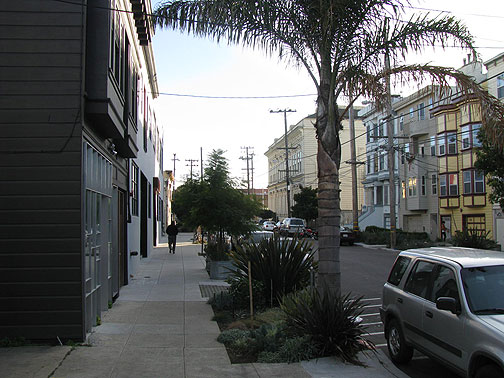 Jane Martin's original garden on Shotwell between 17th and 18th.
This block of Shotwell was infamous for sewage backups and blackwater flooding during heavy rainfall. Only a few years ago most of the neighbors had to stockpile sandbags during winter to stop their garages from flooding with sewage. After Martin figured out how to get through the city bureaucracy, and ultimately helped create a streamlined permit process for anyone to follow (downloadable here http://www.plantsf.org/HowTo.html), many of her neighbors on the same block opened their sidewalks and put in permeable driveways and gardens. Even PG&E, just south of 18th between Shotwell and Folsom, got into the act.
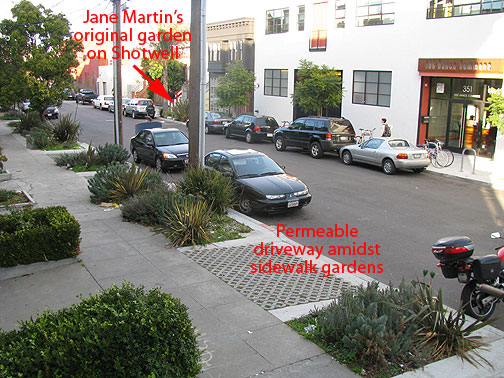 View across Shotwell towards Martin's original garden on east side. 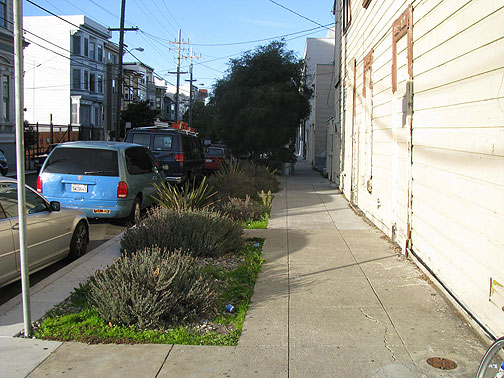 East side Shotwell Street at 18th. 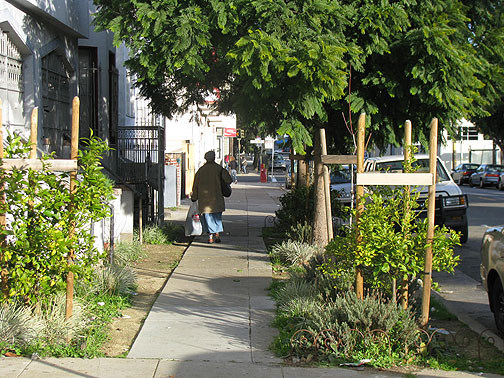 Just around the corner from Shotwell on 18th, north side. 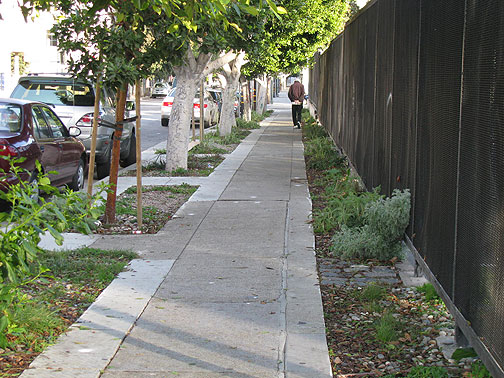 South side of 18th Street just east of Shotwell, side of PG&E property. She started out as something of a lone ranger, using her professional skills to navigate the city’s many rules and regulations, and originally thought the sidewalk-as-park would generate its own enthusiasm.
“I didn’t get very far trying to convince people that it was a nice place for a park. When I realized the connection between the depaving part of the project and getting storm water out of the sewer system and into the ground, that’s when it got more attention, especially from the City because our aging infrastructure with the sewer system is at the point of collapse in a number of areas.”
Continue reading Jane Martin, a Force of Nature
|
Hidden San Francisco 2nd EDITION!
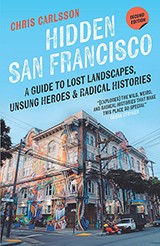
NEW 2nd EDITION NOW AVAILABLE!
Buy one here
(Pluto Press, Spring 2025)
|