Recent Posts
-
I’d Prefer Not To . . .
July 13, 2026
-
Monumental Instability, or War of the Memorials
March 22, 2026
-
Yes, There IS a Future!
December 26, 2025
-
Real Crimes and the Coming Violence
September 6, 2025
-
Whither Modern Life?
June 27, 2025
-
What the Hell
June 18, 2025
-
As Darkness Engulfs Us
April 6, 2025
-
AI, Risk, and Work
January 17, 2025
-
“Things Are in the Saddle, and Ride Mankind”
December 29, 2024
-
Forgotten Futures in Seattle
December 12, 2024
|
We had some awesome torrential rains over the past few days, initiating the new roof on our building (it seems to have done its job!). After my trip through the Amazon and its equatorial rains, then the stormy weather I had in LA, it seems only fair that I’d come home to heavy winter storms in San Francisco too. And we really need ’em, since we’re in the midst of a serious drought. Highly recommend a quick perusal of Tom Englehardt’s latest, “Nobody Knows How Dry We Are,” on the global drought conditions, written as a self-proclaimed amateur, he’s trying to connect the many disparate stories, from Australia’s horrific Great Drying and wildfires, to the droughts besetting Texas, Eastern Africa, Central China, Northern California, and more…
As I rode my bike under pouring rain (and loving it!) I had this rising feeling that we ought to be catching it and trying to save it. Seems an insane waste, to see such incredible quantities of fresh water falling on our asphalted city, and getting whisked away through the sewer system and into the bay (the aging sewer systems around the once-abundant Bay always threaten to dump raw sewage; in Marin a broken system dumped 300,000 gallons of fetid sewage during the storms).
I came home soaked a couple of times…
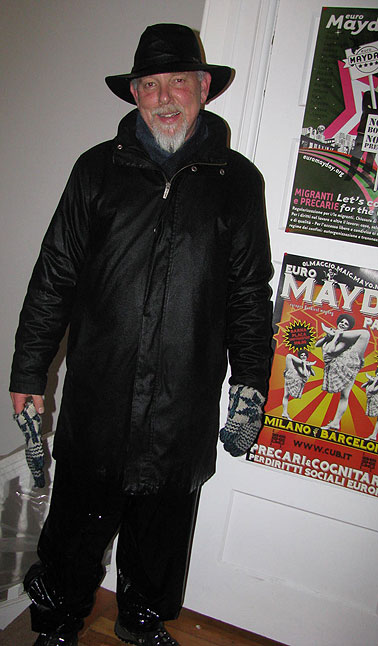 At the top of my stairs, dripping. 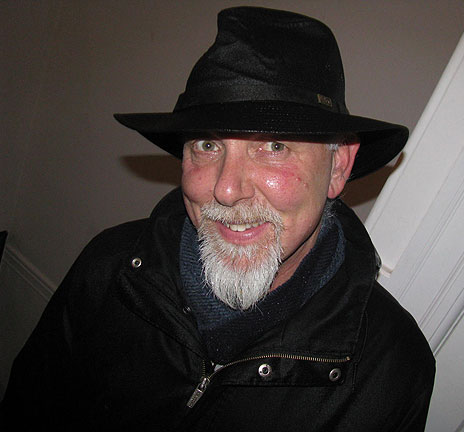 Soaked and happy! I’m swamped with more than water, too… tons of reading materials piling up all the time, still trying to finalize negotiations with the SF Museum and Historical Society on our wiki, foundsf.org. I’m as overwhelmed as the next person trying to keep my morale up in the face of a global collapse and the ever-more dire news about climate change.
But I take heart from the slow convergence of some of my own Nowtopian arguments and those of radical colleagues near and far. Werner Bonefield has published some great collections of radical thought over the past few years, and in this piece he helpfully argues that “The business of negation, the anti in anti-globalization, is the creation of alternative social relations by means of practical critique of existing social relations…”
Continue reading For the Love of Rain
I had a great visit to Los Angeles Feb. 5-9—it overfulfilled my best expectations. Ever since a number of friends moved to LA after the Dotcom bust drove so many people out of San Francisco, I’ve had the feeling that Los Angeles is a far more interesting place than it used to be. I suppose I would have to credit Mike Davis and his “City of Quartz” back in 1990 for starting my own northern California snobbish re-examination of our long disdained southern California brethren. By now, I think a lot of folks in LA are sure they’re way “ahead” of us, partly through sheer size and scale, and partly because there’s an openness and joie de vivre and camaraderie amongst Angelenos that we really don’t approach up here, where everyone is jaded, everyone already knows what the other people are going to say, etc. There’s a certain “stuckness” sometimes in the Bay Area and the people I met in Los Angeles are up against such an overwhelmingly hostile megalopolis, in terms of design, values, and expectations, that those who are in the dissident subcultures are quick to connect with each other. It probably also means that there’s less judgementalness when you meet folks who are in some way standing up for life in a culture so fixated on death.
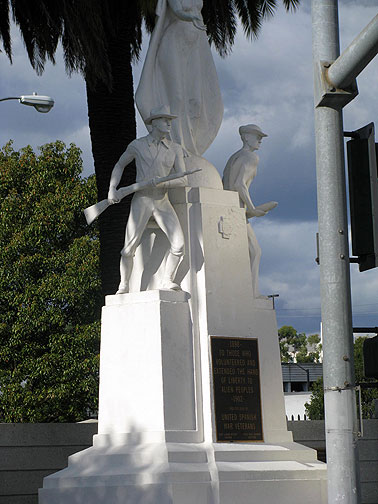 Like our monuments in SF, Los Angelenos also celebrate the genocidal war against the Philippines (we ignorantly still refer to it as the "Spanish-American War") in 1898-1903. 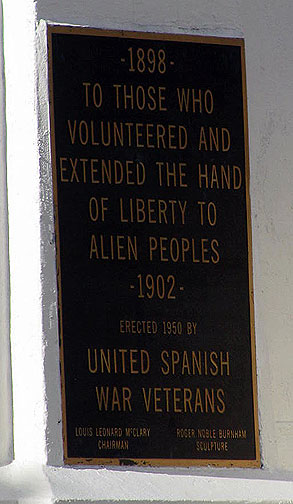 Close-up on the sign on the monument above. I took those shots from my rental car, an oddly LA experience of driving around in a convertible! First time I ever did that!
I got to Los Angeles after six flight legs over 2 days and it was a whirlwind. I did three Nowtopia Talks in the first two days, a Google lunchtime author series on Thursday, and then Friday Feb. 6 at FarmLab at midday, and the Los Angeles Ecovillage at night. The Googlers were funny–at least half of the 25 attendees tapping away at their laptops while I spoke. They asked some good questions and I think it went over quite well. They also videotaped it, simulcasting to Mountain View, but there was no audience feedback from there. On Saturday morning I went into the studio of Killradio.org (my browser says their website will damage my computer! But you can find their shows as podcasts at kpfk.org) and had a rollickin’ good two hours on the air with an ever-changing assortment of bicyclists and even a motocross champion! That night I spoke at BookSoup in West Hollywood to a small crowd, and then on Monday morning I finished my Nowtopia mini-tour at California Institute for the Arts in Valencia, speaking to Andrea Bowers’ class “Lead, Follow, or Get out of the Way! Art, Activism, and Dissent”.
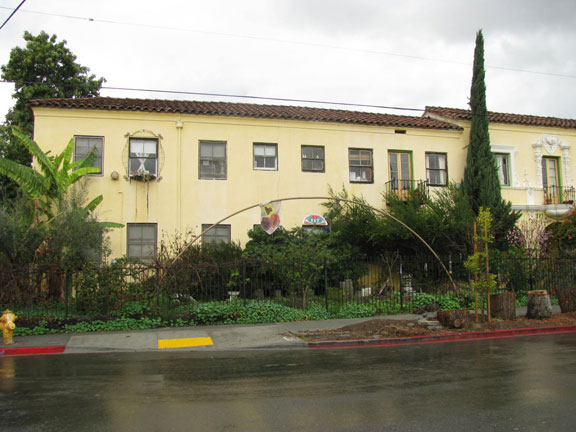 Los Angeles Ecovillage on Bimini Place, my home away from home!
The FarmLab is such a cool place! There’s a certain amount of local grumbling about it because it’s so well-funded, being the main project of Lauren Bon, an Annenberg Foundation trustee and descendent of that uppercrust family. But the conversion of the sprawling warehouses into gallery and meeting and performance space is beautiful, and by all accounts, they do a lot of great stuff there. I presented to about 50 people sitting in a big semicircle on upholstered benches, near a kitchen where a yummy chicken and salad lunch was served to all. Outside an historic viaduct rises to cross the LA river, shadowing weird art pieces, junker cars full of plants, and ironic juxtapositions of many sorts. Jeremy Rosenberg gave me a mini-tour explaining the multiyear experience he was still having (to his own surprise), including the seminal effort called “Not A Cornfield” –a huge adjacent parkland, once an abandoned island amidst freeways and warehouses (not far from Chavez Ravine) where Lauren Bon put in a 32-acre cornfield as an art project. Jeremy gave me a beautiful 2-volume book on it, one full of essays and analyses, the other photos and artistic representations, the books themselves quite elegant artifacts. I’d not heard of the Cornfield project but it was well known to my hosts at the LA Ecovillage, who are in a broad network of like-minded transformative efforts percolating here in LA.
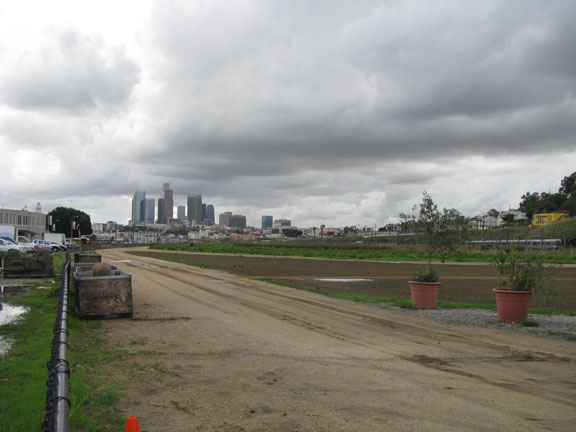 The former "Not A Cornfield" site outside FarmLab. 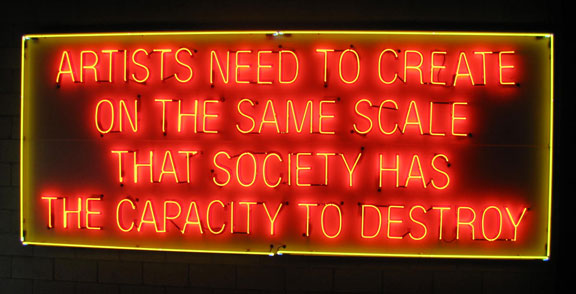 Inside the FarmLab... cool neon signs! Continue reading It’s Happening in Los Angeles!
The World Social Forum celebrated its ninth reunion in Belem, Brazil in the Amazonian state of Pará from January 26 to February 1, 2009. A lot of expectations are piled on to this peculiar event. 91,000 delegates registered, a majority from Brazil, and probably a majority well under 35 years old. But there are hundreds of regular attendees, folks from India, South Africa, Kenya, Nigeria, Sri Lanka, Philippines, Japan, Ecuador, Bolivia, France, Senegal, and dozens of other countries, giving the global south an ample representation. Notably few in number were Americans from the U.S., which I considered something of a relief. There are many representatives of major and minor NGOs and a healthy number of old-style socialist militants too.
The event is a big chaotic mess. It took place on two university campuses, the Federal University of Pará and the Federal Rural University of Pará, separated by about a mile and a half that you could theoretically walk, but most people took the free bus, paid a dollar for a regular bus ride, or took a taxi for about 4-6 dollars. There was also a crazy “put-put” ferry system of small wooden boats that ran from one campus to the other on the Guamá River, which was exotic and fun until you arrived and were stuck for a half hour while the skipper maneuvered his boat into the overcrowded dock area, trying to get a tiny corner to let his passengers out. The Forum program was over 135 pages, mostly small print on large newsprint sheets, listing over 2,000 workshops and roundtables and meetings. In fact, the program was deemed useless by many attendees, as the events were listed at the wrong times, wrong places, and most people I spoke with learned that few of the events they were interested in or in some cases, presenting, were listed at all. (This was true of the three workshops held by Ecologia Urbana of Sao Paolo, one of which was my Nowtopia talk, none of which were listed in the official program.)
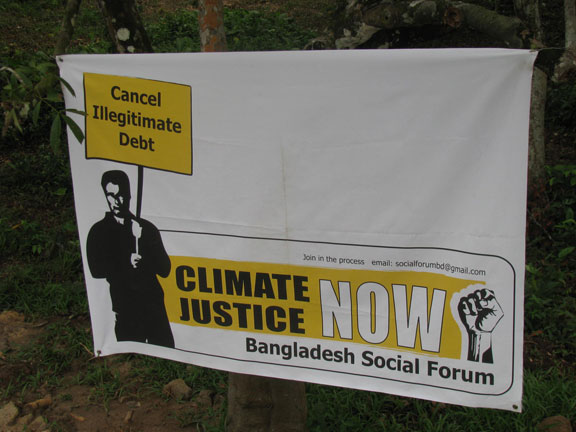 This banner was planted alongside the road on the UFRA campus, but I never saw any of the folks behind it (typically, you could find signs and indications without information on how to meet the people). 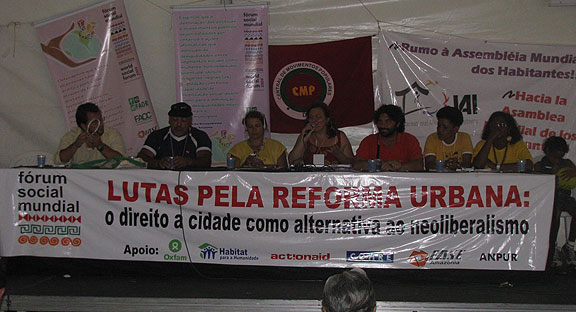 A discussion on urban reform and a much-cited idea, "The Right to the City." 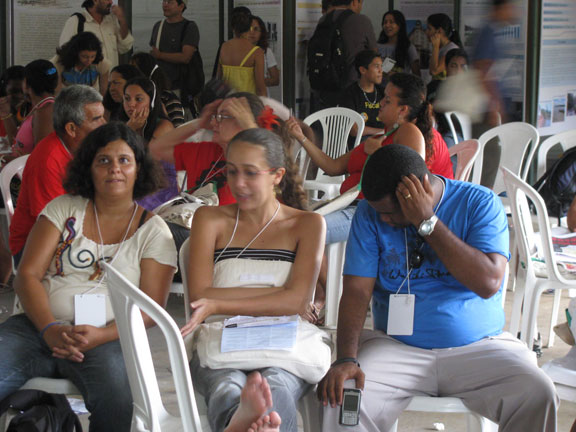 Random snapshot of delegates at Urban Reform talk. Behind the scenes there are several organizational efforts, an administrative office that runs most of the time from Sao Paolo, and is horribly understaffed and overworked. There is also a mysterious International Committee (IC), which is some kind of self-selecting group with representatives from many parts of the world, and many different organizations, but seems to be unaccountable and lacking in transparency. Apparently this IC makes the decisions about where and when the WSF will be held, and what the theme and scope of it will be, and has some say over how the “movement of movements” is brought together and given space to produce all the workshops and discussions and performances that made up the four days of the event. The Brazilian government says it spent $13 million to support the event with extra security in Belem (the city was chock full of police and military), and in subsidizing the facilities, some travel expenses for various delegations, and more. (Though I was in daily contact with some folks who were insiders, it remained opaque and difficult to understand what exactly the process of self-governance was.)
Continue reading Recapping the World Social Forum
|
Hidden San Francisco 2nd EDITION!
NEW 2nd EDITION NOW AVAILABLE!
Buy one here
(Pluto Press, Spring 2025)
|