Recent Posts
-
I’d Prefer Not To . . .
July 13, 2026
-
Monumental Instability, or War of the Memorials
March 22, 2026
-
Yes, There IS a Future!
December 26, 2025
-
Real Crimes and the Coming Violence
September 6, 2025
-
Whither Modern Life?
June 27, 2025
-
What the Hell
June 18, 2025
-
As Darkness Engulfs Us
April 6, 2025
-
AI, Risk, and Work
January 17, 2025
-
“Things Are in the Saddle, and Ride Mankind”
December 29, 2024
-
Forgotten Futures in Seattle
December 12, 2024
|
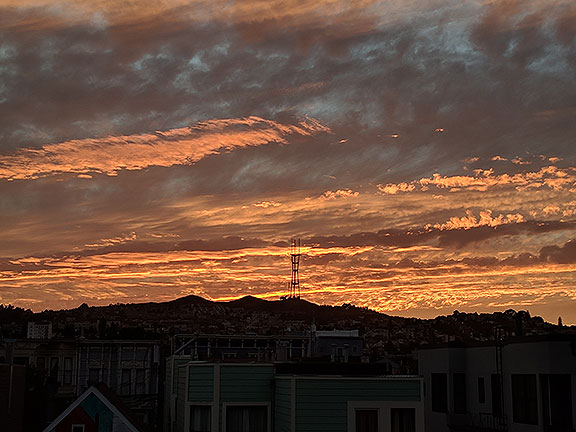 The view from my back window in September… I’m just back from a long week in Guadalajara…. While reading and writing history I never stop thinking about radical social change. And I am continually frustrated with my own isolation, which arises from my critical dissatisfaction with what passes for the Left, whether of the social-democratic or the anarchistic varieties not to mention the older hardline M-L versions which I never embraced even when they were riding a bit higher in the late 1970s. Whether through self-imposed ideological leanings, or through a genuine absence of a dynamic political culture where the debates I think are vital are unfolding, I often feel like I’m stuck in a cul-de-sac—either one that is the dominant culture of extreme right-wing insanity, or the smaller one that is the circular firing squad on the Left.
…at exactly the time when it has become clear that global warming is in every sense a collective predicament, humanity finds itself in the thrall of a dominant culture in which the idea of the collective has been exiled from politics, economics, and literature alike.
—Amitav Ghosh, The Great Derangement (University of Chicago: 2016) p. 80
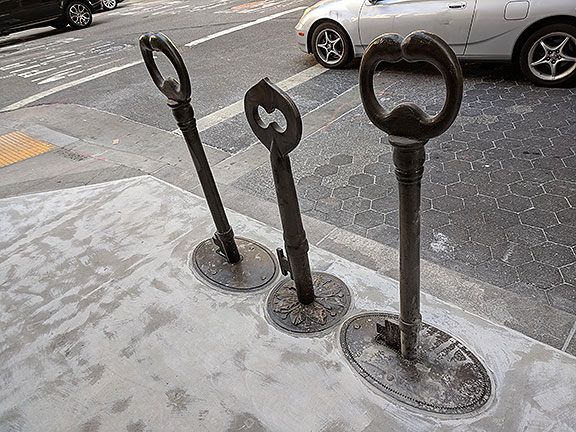 The key to radical social change?… …gig work is part of the individualizing of economic life and financial responsibility. Every man, woman, and child is implored to take personal control of work, retirement, insurance, education, and so forth. Alas, greater responsibility means greater risk of failure. The Gig Economy is the antithesis of collective responsibility and class solidarity.
—Richard Walker, Pictures of a Gone City: Tech and the Dark Side of Prosperity in the San Francisco Bay Area (PM Press: 2018), p. 116
I’m one of those people who have spent my entire adult life, approximately 40+ years now, thinking and scheming about revolution. During a recent Shaping San Francisco Public Talk we had a decent discussion on the revolutionary upheavals of 1968-70, necessarily a bit brief given the format. Preparing for it I read George Katsiaficas’s book The Global Imagination of 1968, which actually concludes that in terms of the U.S., the year 1970 came much closer to the kind of social break that we might call a revolution. In his book he invokes the concept of the “Eros Effect,” which I believe originated with Herbert Marcuse. This is the name he gives to the powerful feeling of connectedness that emerges in times of social conflict and upheaval.
Trying to come to grips with the despair that is always available these days, and remembering that however awful it is (and it is), we do have collective possibilities that feel dormant but could awaken much faster than we can imagine. Remember how quickly the Arab Spring and its doppelgangers in Spain, the U.S., Turkey, Brazil, Korea, and elsewhere spread, amplifying the eros effect across the planet in a matter of months. The people who took those public squares, who occupied those public spaces, who used the internet to augment the face-to-face networks that are the real foundation of radical change, are mostly still alive and well. The forces of repression have destroyed most of those hopeful manifestations from 2011, but the knowledge of how to do it, the people who did it, and the imaginations that know it’s still possible, are all intact. Better still, the dead-ends encountered last time have been pondered, and presumably new tactics will emerge to overcome obstacles, whether self-inflicted or state-imposed, next time.
Between 1968 and 2011, during my lifetime, both the old and new left fractured and shrank to a meaningless set of grouplets, though the cultural revolt that burst forth during the florescent ’60s and ’70s, prominently among women and the LGBT community, continues to fight for hegemony against the resurgent Right. But formal political organizations and ideologies, Democrats and Republicans, Socialists and Conservatives, have withered and are barely a shell of the public arenas of social conflict they once were.
In other words, the public sphere, where politics is performed, has been largely emptied of content in terms of the exercise of power: as with fiction, it has become a forum for secular testimony, a baring-of-the-soul in the world-as-church. Politics as thus practiced is primarily an exercise in personal expressiveness… [As Guy Debord declared:] “The spectacle is by definition immune from human activity, inaccessible to any projected review or correction. It is the opposite of dialogue. Wherever representation takes on an independent existence, the spectacle reestablishes its rule.”
—Amitav Ghosh, The Great Derangement (University of Chicago: 2016) p. 131
Continue reading Exiting the Cul-de-Sac
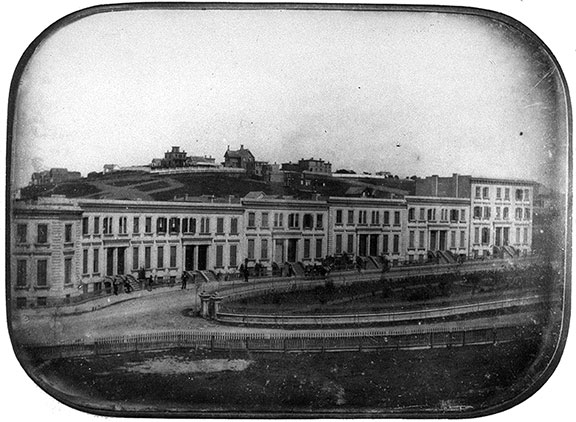 South Park, George Gordon’s original real estate development, c. 1862. The heroic histories of early California have been fed to the state’s schoolchildren, and to the larger culture, since the first wave of American historians began to churn out the self-aggrandizing tales that were meant to exalt the first settlers while painting a simple story of inevitable progress. The real stories are quite a bit more complicated, and in key respects, the reverse of what we’ve been told. California’s jump-started economy in the middle of the 19th century was based not on hardy self-made men, but was based on an industrial model that required large amounts of capital and the abundant natural wealth without which California would have had a very different history. As Andrew Isenberg cogently puts it, “Anglo California’s economic development thus began with industry, later included agriculture, and still later invented wilderness.” (Mining California: An Ecological History, p. 164). The thousands of gold-seekers who rushed to California were themselves imbued with both the white supremacist ideology of Manifest Destiny, and the liberal belief in individualism and personal honor as the foundation of public life. Prior to the Civil War most white men were committed to a republic of individual producers, either small farmers or self-employed artisans and entrepreneurs. The corporation had not yet risen to the powerful position it would assume within a generation, and while plenty of people took jobs working for wages, few thought of it as anything but a transition on the way to self-sufficiency. As Richard White ably describes in his epic history (The Republic for Which It Stands: The United States During Reconstruction and the Gilded Age, 1865-1895, Oxford University Press: 2017):
Free labor depended on independence, and, as Lincoln had said, permanent wage labor signified “either a dependent nature which prefers it, or improvidence, folly, or singular misfortune,” but as the 1860s turned into the 1870s wage labor was becoming not a transitory stage in life but the norm. In 1873 the Massachusetts Bureau of Statistics of Labor proclaimed that wage labor had become “a system more widely diffused than any form of religion, or of government, or indeed, of any language.” Excluding farmers, wageworkers by 1870 outnumbered the self-employed. They did not sell the products of their minds and hands. They sold their hours and days. (p. 237)
It’s not even 200 years since the American seizure of California from Mexico. As Americans poured into the territory seeking their fortunes they aggressively sought to implant a political and economic order that ensured their own well-being and denied it to every everyone else. But they also faced the deep anxiety that accompanied the shifting economic world they were bringing with them, the beginnings of industrial capitalism and wage-labor. The mythological small farmers and self-made men found themselves dependent on wealthy investors and new business syndicates that employed them in seizing the natural wealth of California. While a few became unimaginably wealthy, most American California settlers were boxed in by lack of capital and a lack of land, forced to find employment with those who could command their labor with wages.
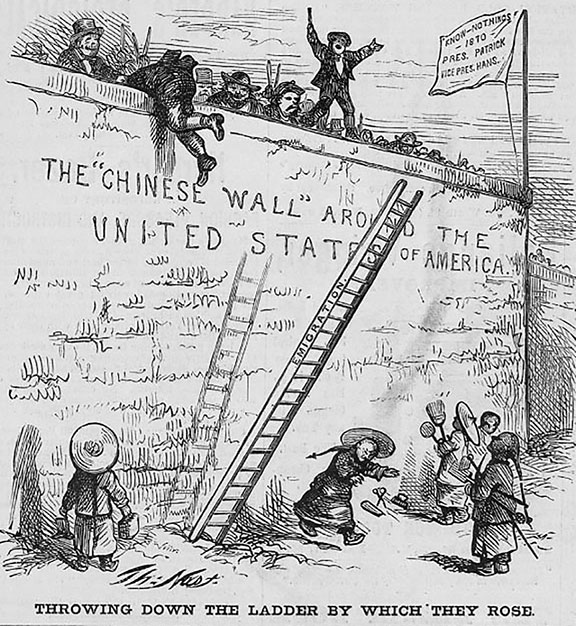 Build the Wall? That first wave of settlers included many southerners who brought slaves with them. Even after California was granted statehood in 1850 as a “free” state, several thousand people of African descent were held in slavery with the backing of fugitive slave laws passed by the California legislature and approved by the California supreme court. But a growing majority of California’s white men, the only ones who could vote, were embracing the “free soil” ideology of the anti-slavery wing of the Democratic Party. The commitment to free white labor meant that any other group, for example, the thousands of Mexicans, Chileans, Peruvians, and other Spanish-speakers who arrived early to the gold diggings, had to be defined as occupying a different category of work. The push for a “foreign miner’s tax” that lasted until 1852 was designed to drive out the so-called peones, or peons, men who were paid a pittance and sent the products of their labor to their patrones, or bosses. The Spanish-speaking gold miners were defined as less than white men by this argument, and thus subject to violent expulsion. After 1852, when most Spanish-speaking miners had departed, the target of white miners was shifted to the Chinese miners. Before long a new claim was being made about the Chinese workers who had signed contracts and come to work in California: they were “coolies.” This process is well described by Stacey L. Smith in her excellent book Freedom’s Frontier: California and the Struggle over Unfree Labor, Emancipation, and Reconstruction (University of North Carolina Press: 2013):
…the question that peonage raised about the relationship between capital and labor, between wage work and slavery, between citizens and aliens, and between empire and exclusion did not disappear with the repeal of the foreign miners’ tax. Instead, white Californians transferred the class, racial, and national imaginings associated with peons to a new group of foreign-born laborers. Within just a year, imagined Chinese coolies took the place of peons and started to represent virtually the same threats and fears. The campaign for Chinese exclusion that emerged in California by 1852 had deep roots in the expulsion of Latinos that preceded it. (p. 94)
Smith offers a wider view of the struggle over different labor regimes during the pre-Civil War decade through the end of Reconstruction in the mid-1870s. Her argument penetrates the fraught beginnings of wage-labor in the pre-Civil War west, and how the struggles over the definition of free and unfree labor came to shape the national discourse by the end of Reconstruction in the mid-1870s. She includes detailed accounts of slavery in California, backed up with many examples and evidence from the press of the time. She goes through the legal battles in the state legislature that led to the passage of the 1850 Act for the Government and Protection of Indians and the fugitive slave law that together rendered California’s ostensible status as a “free state” a mendacious claim at best.
Continue reading Contesting the History of Early American California
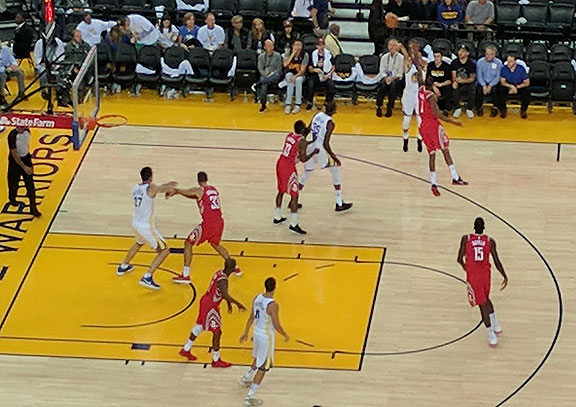 Opening night, Oct. 17, 2017, which the Warriors lost to Houston by 1, but they were champions again by June 2018. Curry has just released a 3-pointer. We are living the glory days of the Golden State Warriors, going to the NBA Finals for the last four years and winning three of them, setting the single season record of 73-9, changing the nature of the game with their long-range marksmanship, unselfish sharing and dynamic flow, and a sustained defensive excellence. This burst of virtuosity on the basketball court has deep roots even it sometimes feels like it emerged suddenly as if from “nowhere.” There is a fascinating decades-long history in which predominantly African American players invented the physicality and creativity that we enjoy so much among stars like Steph Curry and Kevin Durant. Just as vital to the Warriors success is the extraordinary and infectious defensive talents of Draymond Green, skills based on breakthroughs developed by black roommates at the University of San Francisco in the mid-1950s. The “Strength in Numbers” marketing slogan derives from the Warriors’ actual practice of regularly getting all their players into the game, but has come to exemplify a collective, all-hands-on-deck approach that hints at the horizontalist egalitarian politics of Bay Area political movements, too.
It’s worth remembering that their graceful and scintillating game is itself not such a departure from a longer history of NBA basketball. An early Warriors coach Bill Sharman played for the Boston Celtics in 1959-60, a year when the old-school, defensive-minded Celtics scored an average of 124.5 points per game (without any 3-point line to pad the score). The Warriors led the league in 2016-17 at 115.9 points per game. This is partly because of greater athleticism and more complicated defensive schemes that are used now, but the speedy, pass-oriented offense of the Warriors is itself a throwback to the best years of the early NBA. A couple of decades of superstar-focused, grinding isolation offense finally gave way to the uptempo passing game of this era, and to be sure it all feels new again.
The current Warriors are still a shocking departure from decades of mediocrity and failure for us long-suffering fans. But their stellar qualities—relentless defense, improvisationally brilliant team and individual offense, charismatic and politically outspoken stars—all have long pedigrees rooted in Bay Area, basketball, and sports history. Regular readers may wonder why I am writing about sports at all, given the common antipathy to the fully commodified entertainment industry that harbors pro sports along with music, movies, and everything else in our culture. Long-time sportswriter Robert Lipsyte wrote a seminal book in the mid-1970s called Sportsworld: An American Dreamland in which towards the end he captured my sentiment perfectly: “The joy of sport is as real and accessible as the joy of sex; and both have been distorted and commercialized to make us consume and conform.” This reading and presentation of a particular line through history is meant to undergird my ongoing joy and fascination, but also to reinforce the reality that there is much more to this than simply “buying in” to the hype. Similar to how we can give some of Hollywood’s worst output meanings that weren’t necessarily intended or planned for, we can reappropriate and redefine the meaning of our engagement with sports, athletes, and the political world they increasingly intersect.
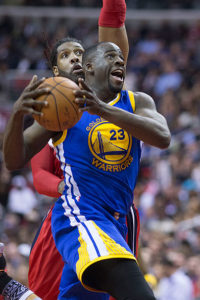 Draymond Green, the defensive soul of the Warriors… very disappointed when he let himself be used for an Israeli Defense Force photo-op in summer 2018. 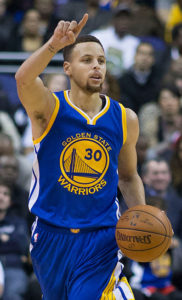 Steph Curry, the two-time MVP and perhaps the best long-range shooter in the history of the game. A necessary prologue to our story is to acknowledge the earliest black basketball pioneers. Harlem’s Alpha Physical Culture Club sponsored the first Black Five, who played in New York City from 1904-1923 against other “black fives” from other athletic clubs in that era. Interestingly, the commitment to early basketball developed among West Indian immigrants in New York who brought the rigidly conservative philosophy of Caribbean sporting culture they’d learned in childhood. Building on the skills developed during these formative years, the New York Harlem Renaissance Big Five, aka the New York Rens, became the best known team of black basketball players, while other teams proliferated by the late 1930s too: Chicago Crusaders, Ciralsky Meat Packers, Philadelphia Tribunes, Cleveland Pennzoils, Chicago Studebakers, Harlem Globetrotters, Washington Bears, and others. After the Rens won the first World Professional Basketball Tournament in 1939 in New York, and the Globetrotters won the subsequent championship in 1940, it belied any claims to superior skills by white players a decade before the formal integration of professional basketball began.
The NBA’s first black players hit the court in 1950, during the second season of the newly formed league, just four years after Jackie Robinson joined baseball’s Brooklyn Dodgers to break segregation in Major League Baseball. Earl Lloyd, Chuck Cooper, and Sweetwater Clifton all played blue-collar roles—rebounding and defending—that first year. During the 1950s, a steady trickle of black players entered the league, but it wasn’t until the arrival of Bill Russell with the Boston Celtics in 1956-57 and Elgin Baylor with the Minneapolis Lakers in 1958 that the boundaries of the game itself noticeably began to shift. We’ll pick up this part of the story in a bit, but first let’s fill in the story that shaped the Bay Area’s love of basketball, gave it an outsized role in the desegregation of the sport, and an even larger role in the long-term revolt of black athletes against the exploitative conditions they were forced to labor under before unionization and free agency.
The NBA’s first African-American all-star was Oakland’s own Don Barksdale, who only played four seasons before injuries ended his career after the 1954-55 season. Barksdale, a Berkeley native, while a boy during the 1930s attended meetings of his father’s union—the Brotherhood of Sleeping Car Porters—and was strongly influenced by its leaders, A. Philip Randolph and C.L. Dellums. A lanky forward, his best years were during and after WWII when he played for the Amateur Athletic Union (AAU)’s Oakland Bittners. He was also a star on the 1948 Olympic team, where during an intrasquad exhibition match on the University of Kentucky campus in Lexington, he broke the Jim Crow color line during a time-out. (The practice match was held to raise money for the Olympic team, but famously racist Kentucky coach Adolph Rupp tried to ban Barksdale from playing. When Barksdale’s coach and teammates threatened to cancel the game, and lose all that important revenue, Rupp grudgingly relented.)
As told by Ron Thomas in his groundbreaking book They Cleared the Lane: The NBA’s Black Pioneers, the Olympic intrasquad game was finally held before 14,000 fans on an outdoor field. During the game, eventually won by Barksdale’s side after a great performance by him, a timeout hushed the fans. A water bucket was brought to the players and a bottle was passed around each huddle. In Lexington, Kentucky in 1948 there was strict segregation including water fountains. When the bottle came to Barksdale he almost turned away but went ahead and had his drink. He passed the bottle on to a gangly white guy from Arkansas who took the bottle and had his drink, rather than tossing the bottle away and reinforcing the Jim Crow rules. The entire audience had been raucous, then dead silent while this took place, and then resumed chattering afterwards, as small actions such as this were still achingly important in those apartheid-like times. A pre-game death threat led to Barksdale fearing for his life during and after the game.
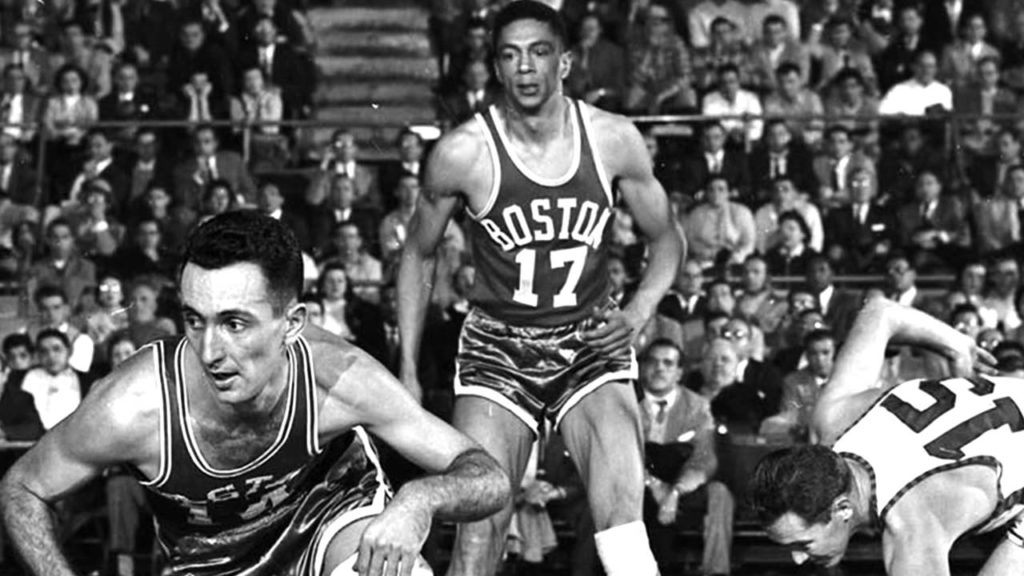 Berkeley’s Don Barksdale, the first African American all-star in the NBA. A year later, back in the Bay Area, a different kind of transgression took place as a commercial venture staged by Frank “Bow Tie” Walsh, a man who “could sell a refrigerator at the North Pole,” according to his wife. Walsh discovered San Francisco’s then-new Cow Palace as a great place to host basketball in 1947, and by 1949 saw a great opportunity. Walsh was friends with Abe Saperstein, the owner of the Harlem Globetrotters (a man who thought he had a proprietary right to all black basketball talent—early NBA owners were afraid to buck him since they depended on doubleheaders with the popular Globetrotters to fill the arenas in a time of low attendance), and thus was very aware of the talent in black college basketball. Knowing that the pre-eminent national tournament then (the NIT) refused to allow black college teams, Walsh invited the best black college team in the nation, West Virginia State College, to play against several of the best teams on the West Coast.
The St. Mary’s Gaels defeated the West Virginia State College Yellow Jackets at the Cow Palace during that first-ever match between a white and black team on the West Coast. It was headline news in the San Francisco Chronicle’s sports pages. Local sports coverage in that era gave as much or more attention to college as professional sports. The professional teams that became the NBA in 1949 were all clustered in the east from Washington to Boston, and from Detroit to St. Louis in the midwest, but the sport was barely a blip in national consciousness. The USF Dons won the NIT in 1949 before a point-shaving scandal tarnished the tournament in 1950. As the NCAA rose to prominence, Bay Area fans were primed for another local team to make a national splash. When the USF Dons became a national power in the 1954-55 season, the entire Bay Area, no more than a quarter of its current size, rallied behind the team, having already watched the new phenom, center Bill Russell, dominate his opponents during his freshman and sophomore years.
Bill Russell was born in Louisiana and moved to the Bay Area as a 9-year-old, landing in Oakland. After a relatively undistinguished high school career at West Oakland’s McClymonds High School his growing height and jumping ability attracted USF coach Phil Woolpert’s attention and he was offered a scholarship. (Incredibly, while Russell played basketball at McClymonds, future baseball stars Frank Robinson, Vada Pinson, and Curt Flood all played outfield there. Two of them would be vital contributors to advancing desegregation and the rights of all athletes in the years ahead: Frank Robinson eventually became the first black manager in baseball in 1975 after a Hall of Fame career, and Curt Flood’s refusal of a trade in 1969 led to a US Supreme Court challenge to the “reserve clause” that kept players under the control of teams for life irrespective of contracts; though Flood lost his case, his challenge is recognized as a vital blow to the system that soon unraveled and led to free agency in baseball and other pro sports.)
Continue reading Jazz of Modern Basketball: Racism and Virtuosity at the Roots of the Champion Golden State Warriors
|
Hidden San Francisco 2nd EDITION!
NEW 2nd EDITION NOW AVAILABLE!
Buy one here
(Pluto Press, Spring 2025)
|