Recent Posts
-
I’d Prefer Not To . . .
July 13, 2026
-
Monumental Instability, or War of the Memorials
March 22, 2026
-
Yes, There IS a Future!
December 26, 2025
-
Real Crimes and the Coming Violence
September 6, 2025
-
Whither Modern Life?
June 27, 2025
-
What the Hell
June 18, 2025
-
As Darkness Engulfs Us
April 6, 2025
-
AI, Risk, and Work
January 17, 2025
-
“Things Are in the Saddle, and Ride Mankind”
December 29, 2024
-
Forgotten Futures in Seattle
December 12, 2024
|
Tag this one as fine whine…
Mexicana airlines is probably among the world’s worst. I’ve had my bad experiences with them in the past, but this trip to Guadalajara has reached a new depth. It all started back in April when I was invited to speak at the 2nd Annual Mexican Cycling Congress in Guadalajara. They kindly offered to cover my airfare, which was handled by a sponsor with lots of frequent flyer miles on Mexicana (their program is known as “Frecuenta”). I was excited since Adriana’s family is mostly in Guadalajara, so she made plans to join me, using some of her surplus of Frecuenta miles to cover her airfare. We had our flights arranged, flying down on the last day of April, going to the conference and then flying home about 10 days later from Mexico City where we planned to go overland…
That’s when the fun started. The Big Flu Scare caused the conference to be postponed, so the tickets were put on hold, pending the new dates. Eventually, after many calls, our friends in Guadalajara got my ticket rescheduled for this trip. The problem is, now we didn’t want to go Mexico City ten days later. We wanted to go home after a week in Guadalajara. The ticket was switched to the right dates, but there was no connecting flight between Guadalajara and Mexico City and we had to return from there! Adriana’s ticket was even more ridiculous because though she got on the same flight down (which itself is just awful–leaving SFO at 12:20 a.m. and arriving in Guadalajara at 6:15 a.m. or 4:15 a.m. for us! no sleep), but her return ticket was scheduled for the same original return date, May 12, but now in 2010!!
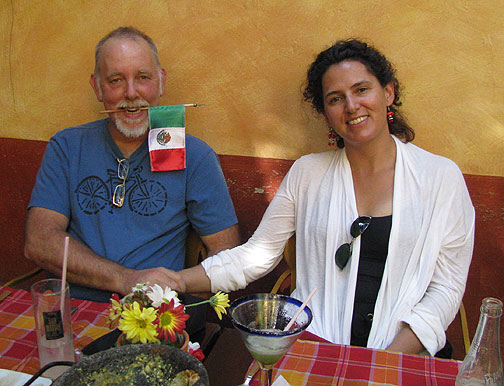 We ate SO well here! Mexican cuisine is among the best in the world, easily! I spent over an hour going through Mexicana’s 800 number in the U.S. trying to rebook my flight to the U.S. direct from Guadalajara. I was told, after 3 different operators passed me along, that I was not able to do it. Only the original Frecuenta account holder could alter the ticket. So I asked the friends in Guadalajara to do it, and they weren’t able to either. We were quite puzzled. Adriana spent two entire afternoons, almost 6 hours, on the phone with various Mexicana operators, trying to change her flight (they were HER miles for her flight), but at first they wouldn’t even credit her with the original miles they’d “spent” on the May trip that got postponed! After many hours she was told her miles had been returned to her. Still she could not alter the return date of the trip! Nor could she change the itinerary to return directly from Guadalajara (though on the phone two different operators had indicated that we COULD change that).
Continue reading Kafka Mexicana
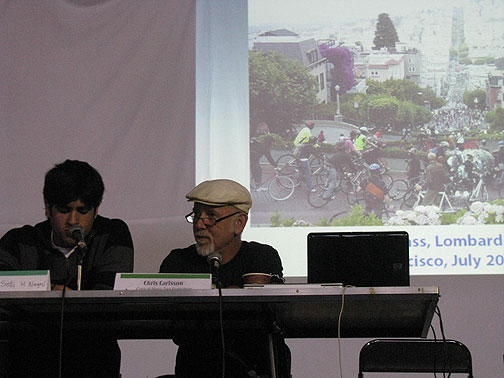 Listening to my introduction from "Negro", Sept. 18, 2009. ¡Gracias por invitarme! Por anticipado, les pido disculpas por mi pobre español. Jamás he intentado hablar públicamente en español, por lo que ruego su indulgencia.
Estoy muy contento de estar en Guadalajara, misma ciudad que mi suegro me explicó, alguna vez fue llamada despectivamente “Pueblo Bicicletero”; pero hoy ese mismo distintivo indica una ciudad mucho más adelantada que atrasada. El ciclismo está disfrutando un nuevo Renacimiento alrededor del mundo. Mi amigo Ted White hizo un corto documental sobre el resurgimiento del ciclismo y le llamó “El Regreso de la Quemadora” (The Return of the Scorcher), un nombre que se le daba a las bicicletas a finales del Siglo Diecinueve porque iban tan rápido que quemaban las calles, de ahà que se le llamó la “quemadora”.
Al reunirnos para discutir ciclismo urbano, es útil recordar que habÃa bicicleteadas en masa de miles de personas en muchas ciudades, incluyendo San Francisco dónde vivo, en los mil ochocientos noventas. En esos dÃas, los ciclistas pertenecÃan a varios clubes y asociaciones, y cuando en julio de mil ochocientos noventa y seis (antes de la invención del automóvil privado) rodaron ocho mil fuertes, los ciclistas tenÃan una demanda: ¡asfalto y Buenas Calles! Quien hubiera imaginado que después los ciclistas serian desplazados de esas mismas calles? ¡A veces obtienes lo que pides pero no resulta exactamente como lo planeaste!
Aun más obscuro en la temprana historia del ciclismo está el papel que jugó esa nueva invención, el tubo o la llanta de hule. Hoy en dÃa, el hule se hace del petróleo, pero a fines del Siglo Diecinueve solamente se obtenÃa mediante la extracción de los árboles de hule en la Amazona o en el Congo. El Rey Leopoldo Segundo de Bélgica tomó control personal del Congo durante esa era imperialista y usó a su ejército para explotar brutalmente a los Congoleños. Eran obligados a extraer cientos de kilos de hule crudo cada pocas semanas, bajo amenaza de ver a sus familias torturadas y asesinadas o perder una extremidad corporal en castigo. Más de un millón de gentes murieron durante este holocausto olvidado, mientras que millones más fueron mutiladas. ¿Qué impulsó esta locura? La creciente demanda de hule en Europa y Estados Unidos de América. ¿Y que impulsó la demanda de hule en los mil ochocientos ochentas y mil ochocientos noventas? ¡Entre otras cosas, la bicicleta! Asà que no podemos olvidar que la bicicleta también es un aparato industrial y tiene su propia obscura historia como la mayorÃa de los aspectos del mundo moderno.
En nuestras modernas ciudades, ahorcadas por automóviles, nosotros los ciclistas somos nuevamente el vehÃculo más rápido sobre la calle. En lo personal, llevó andando mi bici casi cada dÃa desde hace treinta años. Viviendo en San Francisco, con sus famosos cerros y neblina enfriadora, me volvà un experto en utilizar el terreno a mi ventaja. Uno de los placeres escondidos del ciclismo urbano es cómo te revela los secretos olvidados bajo el pavimento. Cuando estás rodando cuesta abajo, te estás aproximando a aluviones históricos que pre-datan la urbanización. Cuando estás pedaleando cuesta arriba, estás dejando atrás aquellos riachuelos y arroyos. En San Francisco el ciclista intrépido de los mil novecientos ochentas–pionero para los muchos miles que empezaron a pedalear desde entonces–estableció muchas de las rutas que ahora son comúnmente utilizadas para evitar subidas empinadas. Un famoso camino se llama The Wiggle o El Meneo por la forma en que vamos meneando por un antiguo caudal, evitando las escaladas empinadas para andar de un barrio a otro mucho más elevado.
En aquellos años pasados, el ciclismo era una experiencia mayoritariamente solitaria. Uno podÃa andar por muchas cuadras y ver a uno o dos otros ciclistas. Hoy es común encontrar diez a veinte ciclistas amontonados en cada luz roja sobre Market Street, la calle principal de la ciudad. Algunos barrios tienen tanta gente sobre bicicletas que ahora nos empezamos a preocupar de colisiones bicicleta contra bicicleta en las intersecciones.
¿Cómo se convirtió San Francisco en tal capital del ciclismo? ¿Cómo ha logrado convertirse en un pueblo bicicletero? Considerando sus montes altos y clima ventoso, a primera vista, no es una ubicación obvia para el ciclismo urbano intenso. Pero algunas docenas de nosotros lentamente avanzamos la causa, principalmente ejercitando nuestro derecho a la calle por medio del ciclismo diario. A finales de los ochenta, los mensajeros sobre bici se convirtieron en una subcultura de la clase trabajadora de la ciudad. Se estilizaron como rebeldes y proscritos y claramente rechazaban vidas laborales “normales” a favor de la relativa libertad de las calles de la ciudad. Los mensajeros fueron una población visible de ciclistas diarios que ofrecÃan una alternativa a los ciclistas cubiertos de spandex y equipo caro y a los ciclistas de carrera, quienes representaban al ciclismo como algo solo para nerds o consumidores adinerados de ciclismo chic.
Continue reading Segundo Congreso Nacional de Ciclismo Urbano, Guadalajara, Mexico, 18 Septiembre, 2009
Listening to my introduction from "Negro", Sept. 18, 2009. Thanks for inviting me! I apologize in advance for my poor Spanish. I’ve never tried to speak publicly in Spanish, so I beg your indulgence.
I’m very happy to be in Guadalajara, which my father-in-law explained to me was once dishonored by the label “Pueblo Bicicletero,” but today that same label indicates a city far advanced rather than behind. Bicycling is enjoying a new Renaissance in most of the world. My friend Ted White did a short documentary on the resurgence of cycling and called it “The Return of the Scorcher,” a name given bicycles in the late 19th century because they went so fast that they burned up the roads, hence “scorching.”
As we gather to discuss urban cycling, it’s useful to recall that there were mass bike rides of thousands in many cities, including San Francisco where I live, in the 1890s. In those days, cyclists belonged to various clubs and associations and when they rode 8,000-strong in July 1896 (before the invention of the private automobile) they had a demand: asphalt and Good Roads! Sometimes you get what you ask for but it doesn’t quite work out the way you plan!
Even darker in the early history of bicycling is the role of that new invention, the air-filled rubber tube or tire. Today rubber is made from oil but in the late 19th century it was only available from rubber trees tapped in the Amazon and the Congo. King Leopold II of Belgium took personal control of the Congo during that imperialist era and used his army to brutally exploit the Congolese. They were ordered to bring in hundreds of kilos of wild rubber every few weeks or have their families tortured and murdered, or even have their own limbs cut off as punishment. Over a million people died during this forgotten holocaust, while millions more were mutilated. What drove this madness? The rising demand in Europe and the United States for rubber. And what drove the demand for rubber in the 1880s and 1890s? The bicycle! So we cannot forget that the bicycle, too, is an industrial device, and has its own dark history like most aspects of the modern world.
In our car-choked modern cities, we cyclists are again the fastest vehicle on the road. Personally, I’ve been riding my bike nearly every day for over 30 years. Living in San Francisco, with its famous hills and cooling fog, I became expert at using the landscape to my advantage. One of the hidden pleasures of urban cycling is how it reveals the forgotten secrets beneath the cement. When you’re rolling downhill, you’re approaching the historic waterways that predate urbanization. When you’re pedaling uphill you are leaving those forgotten creeks and streams behind. In San Francisco, the intrepid cyclist of the 1980s, trailblazers for the many thousands who started cycling in the decades since, pioneered many of the routes that are now commonly used to avoid steep hills. One famous way is called The Wiggle because of how we zig-zag along an old waterway, avoiding steep climbing to go from one neighborhood to a much higher one.
During those long-ago years, cycling was mostly a solitary experience. One could ride for many blocks and only see one or two other cyclists. Today, it is common to find 10-20 cyclists bunched up at each red light on Market Street, the city’s major thoroughfare. Some neighborhoods have so many people on bicycles now that we are starting to worry about bicycle-bicycle collisions at busy intersections.
Continue reading My Speech at the Second National Congress of Urban Cycling, Guadalajara, Mexico, Sept. 18, 2009
|
Hidden San Francisco 2nd EDITION!
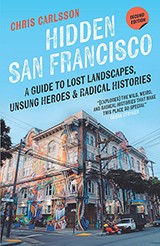
NEW 2nd EDITION NOW AVAILABLE!
Buy one here
(Pluto Press, Spring 2025)
|