Recent Posts
-
I’d Prefer Not To . . .
July 13, 2026
-
Monumental Instability, or War of the Memorials
March 22, 2026
-
Yes, There IS a Future!
December 26, 2025
-
Real Crimes and the Coming Violence
September 6, 2025
-
Whither Modern Life?
June 27, 2025
-
What the Hell
June 18, 2025
-
As Darkness Engulfs Us
April 6, 2025
-
AI, Risk, and Work
January 17, 2025
-
“Things Are in the Saddle, and Ride Mankind”
December 29, 2024
-
Forgotten Futures in Seattle
December 12, 2024
|
I finished reading Mike Davis’s “The Monster at the Door” this weekend. An impressive book, extremely informative, and one that definitely gets an immediate entry into the “Sky is Falling” Hall of Fame. Sheesh! The biggest question I came away with is not if or how there will be a global pandemic that will kill (maybe hundreds of) millions, but why hasn’t it already started? That’s a question plaguing a number of scientists and researchers Davis sources in his book, too.
Davis is at his best when he puts the obvious terror of a super lethal pandemic into the context of the banal trajectory of capitalist development: the ever increasing densities of humans and animals, overlapping in turn with what’s still left of the wild, often mixed in our urbanized concentrations. An interesting insight I didn’t already know: apparently HIV has been definitively traced to humans eating “bush meat” in Africa (i.e. chimpanzees in this case). The crashing fisheries along the coasts of Africa and Asia are leading to a huge increase in industrialized meat making (highly concentrated factories of chickens and pigs) AND rampant exploitation of remaining mammals in the wild, hence more “bush meat.” The radical expansion of hosts for influenza viruses goes hand in hand with this, not to mention other lesser known viral agents in the bush meat (like HIV); all of this new mixing of humans and animals and diseases, combined with the generally underemphasized abysmal state of mega-slums in most parts of the world, set the stage for an inevitable pandemic. Throw in the systematic destruction of existing public health infrastructure, and the abject failure to take seriously the need for a global approach to public health, and you can’t feel anything but a bit helpless in the face of what we can hardly avoid… pandemic lethality as a natural event.
I already knew that the avian flu was something to take seriously. I blogged about it in passing some months ago. There are a number of worthy sites to keep track of, where bloggers and news outlets are tracking the paths of various flu outbreaks. The H5N1 site seems to be a guy up in Vancouver who is doing a great job of sifting through enormous daily flows of information. Bird Flu Today is a more graphic heavy digest of news from near and far. And the Flu Wiki is an attempt to make full use of the new “power” of the wiki form to bring together hundreds of observers and analysts to share the latest on this worrisome topic.
In one of those whimsical and mordant displays of dark humor that daily life is so good at producing, I spent my afternoon yesterday at the 5th annual Green Fest here in San Francisco. It is unquestionably the most self-congratulatory event you can attend hereabouts. Everyone is just glowing with self-righteous moralism, perusing in the mall of correct shopping, getting endlessly patted on the back by other attendees, speakers, and vendors.
Continue reading Monster at the Door, Gardens on the Roof
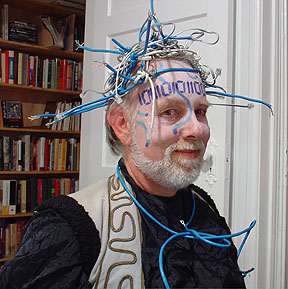
Every year San Francisco goes increasingly bonkers over Halloween. A lot of us who have been living around here for a long time want to avoid the Castro and its frenzied insanity like the plague. But getting out in to the city and enjoying ourselves in costume is still a great desire. So Mona made the brilliant proposal to meet at the dark triangular lot at 24th and Capp (the old railroad right of way) at 9:13, and then promenade from there after a while… about two dozen friends joined us, and as we started westward on 24th, another unknown group of 50+ appeared. The woman leading them told me she had asked everyone to leave the party at her house and head into the streets together. Seems to have been a natural instinct of locals… sure enough on Valencia we found hundreds more, and for a while, we had a regular Mission version of Halloween… Here I am before leaving the house (this is the first time in my 48 years I let anyone paint anything on my face!):
Do not look into your computer screen for too long, because if you do, I WILL appear, and if I look at you, you will turn to stone, because I am Digital Medusa…
Tonight is Dia de los Muertos, a storied tradition from Mexico and points further south, which has been fully embraced by the hybrid culture of San Francisco’s Mission district. If you read this today, I really recommend getting over here tonight around 7 to join the procession. It’s always quite moving in mysterious ways, and a remarkable street event. Bring your drum if you have one!
Continue reading Halloween and Dia de los Muertos
This morning I finished Dave Zirin’s really great book of essays What’s My Name, Fool?: Sports and Resistance in the United States. If you’re any kind of a sports fan AND a critical thinker, you will really enjoy it. This is one of the first books I can even think of to take up a whole range of important events, characters and themes from a point of view that finally feels like a real thinking person is behind it. I’ve had glimmers of that once in a while in the past, say from Scott Ostler at the old SF Chronicle, but he slid away from it… even Bruce Jenkins at the Chron seems like a smart guy a lot of the time, but he avoids taking a political stand except in the narrow terms of a given sports controversy. Zirin goes whole hog into racism, homophobia, corruption, drugs, war and peace, free speech and dissent. I’ve seen his essays as they’ve popped up occasionally on Common Dreams, but now I realize he has his own web column. So check it out! You can fill in your own blank spots on why Ali is SO important in our history, the story of the 1968 Olympics (just commemorated by Rigo’s new sculpture at San Jose State), who the outspoken anti-war athletes are now, why we should never support building a new stadium anywhere, and much more.
Reading the book took me back through a lot of my own personal history. I was a huge jock and sports fan as I grew up. I actually had a lot of interesting experiences: I shook Cassius Clay’s hand (before he became Muhammad Ali) when he visited my 3rd grade class in Chicago. I fell in love with soccer when I was about 8 and started organizing all my friends in the apartment building into a team, and convinced some kids on a nearby block to do the same so we’d have someone to play against (this was in Hyde Park around 1966). Later I moved to Oakland in the summer of 1967 and became a huge fan of the Oakland Clippers (leaving behind my beloved Willie Roy and the Chicago Spurs–both teams played in the long-defunct National Professional Soccer League, which became the NASL North American Soccer League), and played youth soccer around the East Bay. I really BELIEVED in soccer, in a way that I later came to believe in socialism or revolution or whatever label I attached to a project of generalized human liberation. It’s odd to recall how strongly I felt those emotions, and how strong the continuity is between the passion, loyalty, love of community, camaraderie, etc. that I felt for my soccer world and later for the political world. I even got to play on the field at the Oakland Coliseum at halftime of an exhibition game between the Oakland Clippers and Santos do Brasil, starring none other than Pele!
I arrived in Oakland the same summer as the Kansas City Athletics moved to Oakland, with a young phenom named Reggie Jackson. In August of 1967 I saw him crash the right field wall catching a ball and turn and throw a laser beam strike to home to double up a runner tagging from third during a game against Frank Howard and the Washington Senators… nothing could have astonished me more at the time. The throw didn’t even bounce! He was known for his bat and his mouth, but as a young player he had a cannon for an arm, too.
I brought my love of the Cubs with me, so some years later when Ken Holtzman, a left-handed starter, came to the A’s I was thrilled. He’d been my hero when I was nine or so. I got to carry his golf bag, along with that of Rollie Fingers, in the fall of 1973, after they’d won two straight World Series… that demystified them a bit, but it was very fun to see them up close and personal. I went to the unbelievable World Series of 1972, the bearded, long-hair Swingin’ A’s against the crewcut militaristic Cincinnati Reds (Pete Rose, Joe Morgan, Johnny Bench), which vindicated our politics so clearly when the hippie A’s beat the marine-Reds in 7 games, 3 of them decided by 3-2 scores and six games by one run.
Continue reading Sports as History
|
Hidden San Francisco 2nd EDITION!
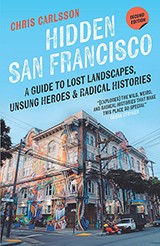
NEW 2nd EDITION NOW AVAILABLE!
Buy one here
(Pluto Press, Spring 2025)
|