Recent Posts
-
I’d Prefer Not To . . .
July 13, 2026
-
Monumental Instability, or War of the Memorials
March 22, 2026
-
Yes, There IS a Future!
December 26, 2025
-
Real Crimes and the Coming Violence
September 6, 2025
-
Whither Modern Life?
June 27, 2025
-
What the Hell
June 18, 2025
-
As Darkness Engulfs Us
April 6, 2025
-
AI, Risk, and Work
January 17, 2025
-
“Things Are in the Saddle, and Ride Mankind”
December 29, 2024
-
Forgotten Futures in Seattle
December 12, 2024
|
I’ve been grappling with ideas about “Precarity” and class for a while now. There’s not a whole helluva lot of thinking or writing going on around this in the U.S. that I can really identify with, but yesterday I got two things in my email box. One is a link to a pamphlet distributed at the Gleneagles Scotland G8 meeting called “Event Horizon” by a collaboration of folks in Leeds, Chicago and Scotland. I highly recommend it.
The other thing I got was a rather rough translation of a piece called a “Precarious Lexicon” from a Spanish group Precarias a la Deriva. The Lexicon is a solid bit of theoretical work, and the two pieces go hand-in-hand beautifully. The Spanish text (if you want the English translation I got, email me and I’ll send it to you) connects the discussion to the eruption of the May Day carnivals in first Italy and then now across 16 European capitals this past year.
In 1998, 1999 and to a lesser extent in 2000 a bunch of us got together around here and pulled off these “Reclaim May Day” parades and fairs that were really exciting and hopeful at the time. David Solnit and Alli Starr and the Art & Revolution folks were instrumental in making it happen, so when they threw themselves into Seattle organizing in 1999 it sapped the energy for the 2000 Mayday, and then the event petered out after that. But reading the two pieces above reminded me that I’d been feeling the urge to re-reclaim May Day in 06 with a radical parade/carnival… any takers?
I’m feeling the continuity of our local scene more strongly right now, after Punx Against War held a really great punk show at CounterPULSE on Friday night. It was an impromptu affair, since we hadn’t really been thinking we could or would be hosting punk shows there (now I think we’ll definitely want to make it happen at least a few times a year). But they got evicted from their squat across the street at the former Guitar Center a couple of days before their big inaugural concert there, and lo and behold, we had a sweet, artistic, inspiring evening. I had that delicious taste of past venues, old friends, echoes of my own youthful love of c. 1979 punk rock (esp. the Onion-Flavored Rings–yowza!). Some old Komotionistas showed up, and tons of new kids too, some of whom are organizing free events, concerts, discussions on Peak Oil, the Really Really Free Market in Dolores Park last Sats. of the month, and so on.
San Francisco ain’t dead yet! And I gotta say, I put a shitload of energy into helping CounterPULSE get open and wouldn’t have done it if it couldn’t at least resemble in a limited way the openness and serendipity and synchronicity of a Social Center in the European style… Friday night’s punk show was the best confirmation yet that we’re going to be able to pull it off.
I don’t know how many people, like me, lived through the political era of Nixon, Watergate, and the Vietnam War, but if you did, these days are even more profoundly discouraging than usual. The cliche about reliving history the second time as farce is part of it (though it’s way too barbaric and bloody to be merely farce), but there’s also the bizarro funhouse inverse world that so much of the spectacle seems content to reproduce so blithely.
I’ve been feeling kinda blue lately, and haven’t really been able to put my finger on why. A good friend called last week, rather distraught and admitted that she’d been unnerved by the London bombings. I don’t really react directly to such horrors, or I don’t think I do. But maybe I have a delayed reaction sometimes. In the case of the London bombings there’s the obvious disparity between the intense horror at the barbarism of such an attack and the rather calm, matter-of-fact tolerance of the everyday news out of Iraq which consists of much the same level of mayhem. So I can’t get too worked up about the London story as somehow so much more terrible than any other part of the madness in the world, especially considering that it’s so plainly connected.
Continue reading Not Again (or Again AND Again!)
There’s a new documentary in town, originally a French production with a farcical narrative, it’s been re-narrated in English as a more straight-ahead doc on the Emperor Penguin of Antarctica (March of the Penguins). Since I’m currently reading Kim Stanley Robinson’s “Antarctica” it was a good time to see this film and get a good look at the icescape of that little-known continent. But it was a great match with Jeremy Narby’s new book Intelligence in Nature: An Inquiry into Knowledge.
The Emperor penguins, as seen in this film, are remarkably human. But forgoing the obvious anthropomorphism of that notion, the specific behaviors of the penguins show remarkable intelligence. And that begs the same question as Narby’s book, ‘what is intelligence’? It turns out that the harder one tries to arrive at a working definition of ‘intelligence’ the more elusive it becomes. Narby quotes a plant biologist’s definition: “adaptively variable behavior during the lifetime of the individual”. This tries to encompass a wide range of observable behaviors that are inadequately explained as mere reflex responses to chemical signals, or any of the other myriad relatively mechanical explanations that have been commonly proffered by scientists for the past 200 years. What makes Narby’s book so interesting is his rational and rigorous attempt to discover and explain (mostly in other scientists’ work) the evidence of intelligence that has been held as a given by so-called primitive peoples who live in, e.g., Amazonian jungles.
Continue reading Penguins Do the Darndest Things!
|
Hidden San Francisco 2nd EDITION!
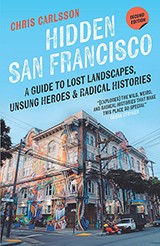
NEW 2nd EDITION NOW AVAILABLE!
Buy one here
(Pluto Press, Spring 2025)
|